WATCH: The Honey Badger Facts in the Wild
In this Petnarianpets video, we dive into the daily life of the most fearless creature on the planet. Watch as it takes on venomous snakes and holds its ground against the kings of the savanna.
The biology and fearless behavior of the honey badger (Mellivora capensis). Learn about its unique venom resistance, opportunistic diet, and remarkable survival strategies at PetNarianPets.
Table of Contents
The Legend of the Fearless Mustelid
In the vast and unforgiving landscapes of Africa and Asia, there exists a creature that has earned a reputation far exceeding its modest size. The Honey badger, also known as the ratel, is frequently cited as the most fearless animal in the world. This title is not merely hyperbole; it is a recognition granted by the Guinness World Records and supported by decades of field observations. At Petnarianpets, we are fascinated by the sheer audacity of this animal, which refuses to back down from predators ten times its size, including lions and leopards.
The reputation of the ratel is built upon a foundation of incredible physical toughness and an aggressive temperament. While most animals in the savanna rely on speed or camouflage to survive, this member of the Mustelidae family relies on a “never-say-die” attitude. This fearlessness is not born of ignorance but of a highly specialized evolutionary toolkit. From its rubbery, thick skin to its immunity against some of the world’s most potent neurotoxins, every fiber of the animal is designed for high-stakes survival.
Despite its name, the animal is not a true badger in the sense of the European or American species. It is a unique evolutionary branch that has perfected the art of the defensive offense. In this deep-dive article, we will explore the Honey badger facts that separate the viral internet sensations from the biological reality of this incredible predator. Whether you are a nature researcher or a wildlife enthusiast, understanding the ratel is essential to appreciating the diversity of the carnivorous order.
Scientific Lineage and Evolutionary History
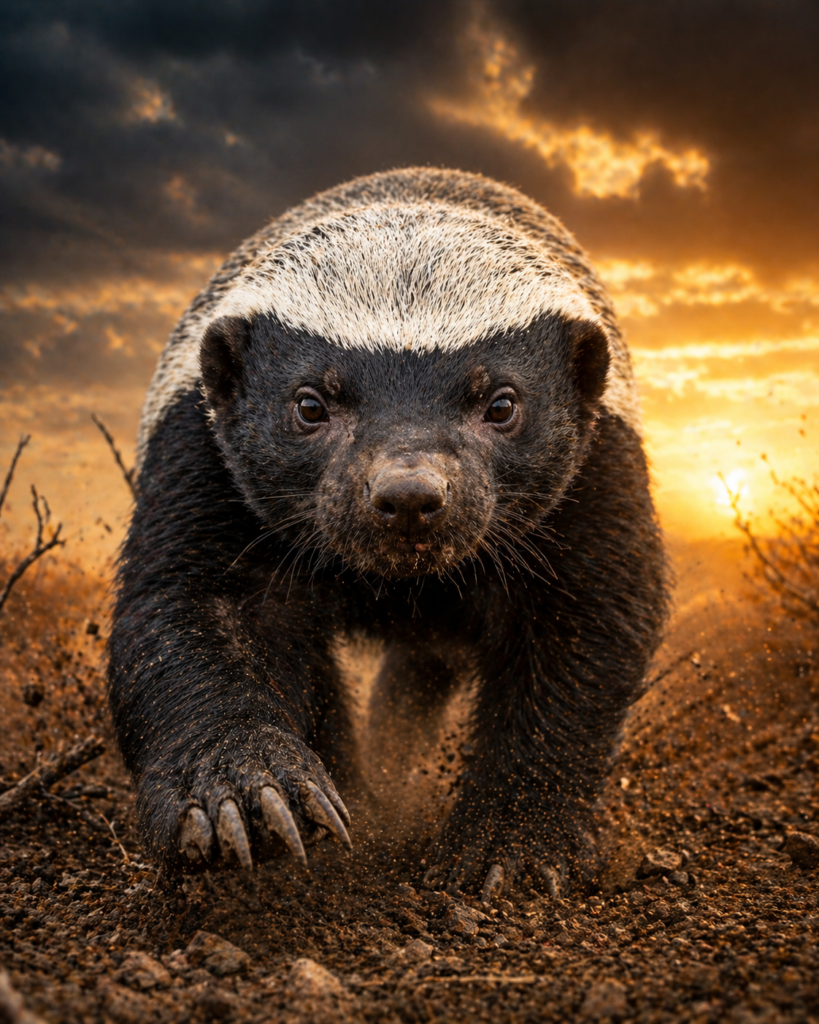
The Mellivora capensis is the sole extant species in the genus Mellivora and the subfamily Mellivorinae. This monotypic status is significant in biology; it indicates that the ratel is the last remaining representative of a lineage that has outlasted its prehistoric relatives. Its ancestors can be traced back to the Miocene epoch, roughly 7 million years ago. During this time, larger relatives like the Eomellivora roamed across Eurasia and North America, possessing even more formidable dental structures designed for crushing bone.
The modern ratel is more closely related to weasels, otters, and ferrets than it is to the “true” badgers found in the Northern Hemisphere. This distinction is important for understanding its physiology. While European badgers are primarily social and somewhat docile foragers, the Mellivora capensis has evolved into a solitary, nomadic hunter. Its evolutionary path has prioritized brute strength and skin durability over social complexity, resulting in an animal that is essentially a mobile fortress.
Biological Profile and Quick Facts
To understand the scope of this animal’s capabilities, we must look at the data. Below is a comprehensive profile detailing the essential statistics of the species.
| Field | Data Detail |
| Classification | Order: Carnivora, Family: Mustelidae, Subfamily: Mellivorinae |
| Scientific Name | Mellivora capensis |
| Habitat | Arid grasslands, savannas, and montane forests of Africa and SW Asia |
| Diet | Omnivorous: Small mammals, reptiles, insects, fruit, and beehives |
| Lifespan | 7–8 years in the wild; up to 24 years in captivity |
| Superpower” or Special Feature | Near-immunity to snake venom and loose, impenetrable skin |
| Natural Predator | Lions, Leopards, and Spotted Hyenas (rarely successful) |
| Natural Prey | Puff adders, cobras, rodents, and scorpions |
Is the honey badger related to the skunk?
One of the most frequent questions we receive at Petnarianpets is: Is the honey badger related to the skunk? Historically, skunks were classified within the Mustelidae family alongside the ratel. However, modern genetic testing has moved skunks into their own family, the Mephitidae. While they are no longer in the same family, they are both part of the superfamily Musteloidea, making them “distant cousins.”
The confusion often stems from their shared defensive mechanism: the anal scent gland. Much like a skunk, the ratel can release a foul-smelling secretion when threatened. However, while a skunk uses its spray as a primary deterrent to keep predators at a distance, the ratel uses its scent as a “stink bomb” during close-quarters combat. The odor is reportedly suffocating and can disorient an attacker, providing the ratel with an opening to strike at the predator’s sensitive areas. This shared trait is an example of convergent evolution, where two distinct lineages develop similar tools to solve the problem of self-defense.
Anatomy of Resilience: Skin and Teeth
The Honey badger speciality lies in its incredible anatomical defenses. The most famous of these is its skin. The skin of a ratel is approximately 6 millimeters thick around the neck—thicker than the hide of a Cape Buffalo. More importantly, the skin is remarkably loose. If a predator like a lion manages to grab the ratel by the scruff of its neck, the ratel can literally turn around inside its own skin to bite the predator’s face. This “internal mobility” makes it nearly impossible to pin the animal down safely.
Furthermore, the Honey badger teeth are specialized for a broad diet. They possess powerful carnassial teeth for shearing meat, but their molars are also capable of crushing the shells of tortoises or the bones of small mammals. Their jaws are so strong that they can eat every part of their prey, including the teeth and hide. This efficiency ensures that in a nutrient-scarce Honey badger habitat, no part of a kill goes to waste.
The Defensive Arsenal: Honey badger venom resistance
Perhaps the most scientifically intriguing aspect of this animal is the Honey badger venom resistance. Many nature enthusiasts ask: Can a honey badger survive a snake bite? The answer is a definitive yes. These animals frequently hunt some of the world’s most dangerous snakes, including the King Cobra and the Puff Adder.
Research has shown that the ratel has evolved specific genetic mutations in its nicotinic acetylcholine receptors. In most mammals, snake toxins bind to these receptors, causing paralysis and respiratory failure. In the ratel, the receptors are shaped in a way that prevents the toxin from binding effectively. While a bite from a cobra might knock a ratel unconscious for several hours, the animal’s metabolism eventually neutralizes the toxin, and it simply wakes up and finishes eating the snake. This level of chemical resilience is almost unparalleled in the mammalian world.
Global Distribution: Where do these mustelids roam?
If you are looking for the Honey badger habitat, you will need to look across a vast geographic range. They are found throughout most of sub-Saharan Africa, from the Western Cape of South Africa to the southern edges of the Sahara Desert. Beyond Africa, their range extends into the Arabian Peninsula, Iran, Turkmenistan, and the Indian subcontinent.
They are incredibly adaptable to different environments. You can find them in scorching deserts, lush rainforests, and even high-altitude montane regions. The only environments they typically avoid are extreme hyper-arid deserts and the densest parts of the equatorial jungle where movement is restricted. Their nomadic nature means they do not have a permanent den; instead, they take over the burrows of other animals like aardvarks or warthogs, or they simply find a crevice in the rocks to rest for the day.
The Culinary Range: What do honey badgers eat besides honey?
The name suggests a sweet tooth, but it is a bit of a misnomer. While they do love the larvae and honey found in beehives, people often ask: What do honey badgers eat besides honey? The reality is that they are highly opportunistic omnivores. Approximately 80% of their diet consists of animal matter.
They are voracious hunters of rodents, lizards, and frogs. They are also famous for their “digging” hunting style. Using their long, sturdy claws—which can reach up to 4 centimeters in length—they can excavate a burrow in minutes to reach a hiding rodent. They also consume fruit, tubers, and roots during the dry season when animal prey is scarce. Their ability to eat scorpions and spiders without being affected by the stings further highlights their status as the desert’s most versatile diner.
Social Dynamics: From Mating to the Honey badger baby
The life of a Honey badger baby (or kit) is one of intense education. Ratels are solitary animals, and males and females only come together briefly for mating. The gestation period lasts approximately six months, after which a single kit (rarely two) is born. The baby is born blind and hairless, completely dependent on its mother.
The mother ratel is exceptionally protective. She will move the Honey badger baby to a new burrow every few days to avoid detection by predators. Unlike many other carnivores that mature quickly, a young ratel stays with its mother for up to 18 months. During this long dependency period, the mother teaches the kit how to dig, how to handle venomous snakes, and how to defend itself against larger predators. By the time the kit leaves to find its own territory, it has already been “battle-hardened” by one of the toughest teachers in nature.
Apex Confrontations: Honey badger vs lion
The internet is full of clips showing a Honey badger vs lion confrontation, and the results are often shocking. While a lion is certainly capable of killing a ratel, it rarely finds the effort worthwhile. Because of the ratel’s thick, loose skin and its ferocious “all-out” defensive style, a lion often ends up with a scratched face and bitten paws before it can land a killing blow.
Lions and leopards are smart predators; they calculate the risk-to-reward ratio of every hunt. To a lion, the ratel is a small, incredibly difficult, and potentially injurious meal. Most lions will harass a ratel out of curiosity or territoriality but will eventually let it go when they realize the ratel will not stop fighting. There are documented cases of a single ratel holding off a pride of lions for over an hour, eventually walking away unscathed while the lions look on in confusion.
Cultural Impact: The Legend and the Honey Badger Gun
The reputation of the ratel has transcended biology and entered human culture, particularly in the realms of technology and defense. The Honey Badger gun, formally known as the AAC Honey Badger PDW, is a high-profile firearm designed for stealth and power. It was named after the animal precisely because of its “small but deadly” nature and its ability to perform in high-stress environments.
Furthermore, the “Honey Badger Don’t Care” viral movement of the early 2010s brought this animal to the forefront of global pop culture. While the video was humorous, it correctly identified the animal’s most defining trait: its utter lack of concern for social hierarchy or the physical threats posed by other creatures. In many cultures, the ratel is a symbol of perseverance and the underdog spirit.
Management and Conservation Status
Currently, the Mellivora capensis is listed as “Least Concern” by the IUCN. They are widespread and resilient. However, they face significant challenges in areas where they overlap with human agriculture. Because they are clever and strong, they often break into chicken coops or destroy commercial beehives.
This leads to “retaliatory killing” by farmers and beekeepers. In some regions, the use of gin traps and poison has led to local population declines. Conservation efforts are now focused on “Badger-friendly” farming practices, such as elevating beehives on stands that the ratel cannot climb. At Petnarianpets, we advocate for these co-existence strategies, as the loss of this apex mustelid would have a cascading negative effect on the balance of the ecosystem.
Frequently Asked Questions (FAQ)
What makes the honey badger so “tough”?
Its toughness comes from a combination of skin that is 6mm thick and loose enough to turn around in, a reinforced skull, and a specialized immune system that is resistant to snake venom and many bee stings.
Where do honey badgers live?
They are found across most of Africa, the Arabian Peninsula, and parts of India and Central Asia. They live in a variety of habitats, including savannas, forests, and semi-deserts.
Are honey badgers rare or endangered?
No, they are currently classified as “Least Concern.” However, they are naturally solitary and live at low densities, so they are not frequently seen in the wild.
Do they actually eat honey?
Yes, but they are primarily interested in the bee larvae (brood) found inside the hive, which provides high protein. The honey is a secondary treat they consume during the process.
Why are honey badgers so aggressive?
Their aggression is a defensive strategy. By being extremely loud and violent when threatened, they convince much larger predators that they are not worth the risk of an injury.
Can a honey badger survive a snake bite?
Yes. Due to genetic mutations in their nervous system, they are resistant to the venom of cobras and adders. They may go into a temporary coma but usually recover fully within a few hours.
The Enduring Legacy of the Ratel
The Honey badger is more than just a viral sensation; it is one of the most successful evolutionary designs in the mammalian world. It challenges our understanding of the predator-prey dynamic, proving that size is not the only factor in survival. Through its unique Honey badger speciality of venom resistance and its impenetrable hide, it has carved out a niche as the ultimate survivor of the African and Asian wilds.
At Petnarianpets, we remain dedicated to bringing you the most accurate and engaging Honey badger facts. By respecting the boundaries of these incredible animals and supporting conservation efforts, we can ensure that the “most fearless animal in the world” continues to roam our planet for millions of years to come. Whether you are watching a Honey badger video or reading about their exploits, the message is clear: respect the ratel, for it truly does not care about the odds.
Stay wild, stay curious – only on PetNarianPets!
Join The Fun On Instagram, X, Pinterest and YouTube.
Wanna Say Something about animals ? Contact Us.