
[WATCH: The Secret Life of the Tiputini Velvet Worm – New Species Reveal
Table of Contents
The Ancient Lineage of the Amazonian Undergrowth
The dense, humid corridors of the Ecuadorian Amazon wildlife reserves have long been known as a cradle of biodiversity, sheltering millions of species that have remained unchanged for epochs. Among these, the velvet worm stands out as a biological anomaly. Neither a worm in the traditional sense nor an insect, these creatures belong to the phylum Onychophora, a group of terrestrial invertebrates that serve as a bridge in our understanding of arthropod evolution. The recent scientific description of the Tiputini velvet worm facts has sent shockwaves through the entomological community, highlighting just how little we still know about the deep jungle floor.
Often described as “living fossils,” velvet worms have maintained a remarkably consistent body plan for over 500 million years. Their presence in the fossil record dates back to the Cambrian explosion, making them older than the dinosaurs and even many of the ancient trees they inhabit today. Petnarianpets has followed the journey of researchers in the Yasuní Biosphere Reserve to bring you the most comprehensive data on this newly identified predator, which combines a soft, velvety exterior with a lethal, high-tech hunting strategy.
Scientific Classification and Statistical Overview
The formal identification of Oroperipatus tiputini represents a significant milestone for Onychophora Amazonia research. While many velvet worms look similar to the untrained eye, the Tiputini variant possesses unique genetic markers and morphological traits that distinguish it from its cousins in the Andean foothills. Below is a detailed biological breakdown of the species as compiled by the research teams at Petnarianpets.
| Field | Data Detail |
| Classification | Phylum: Onychophora, Family: Peripatidae, Genus: Oroperipatus |
| Scientific Name | Oroperipatus tiputini |
| Habitat | Primary lowland rainforest leaf litter (Tiputini Biodiversity Station) |
| Diet | Carnivorous (Invertebrate specialist) |
| Lifespan | 5 to 8 years (estimated based on related Neotropical species) |
| Superpower” or Special Feature | Dual high-pressure “slime cannons” for prey immobilization |
| Natural Predator | Large centipedes, forest birds, and small rodents |
| Natural Prey | Crickets, termites, small spiders, and woodlice |
Where Was the New Velvet Worm Found in Ecuador?
The discovery of the Velvet worm new species 2024 took place within the pristine confines of the Tiputini Biodiversity Station. This area is situated on the northern bank of the Tiputini River and is part of the Yasuní National Park, widely considered the most biodiverse place on Earth. Researchers from the Universidad San Francisco de Quito and international collaborators spent months sifting through the moist “terra firme” forest floor to locate specimens of this elusive predator.
Finding a Tiputini velvet worm is no small feat. These animals are photophobic, meaning they have a natural aversion to light, and are almost exclusively nocturnal. They rely on the absolute darkness of the forest night and the high humidity of the rainy season to venture out from their hideouts in rotting logs and deep leaf litter. The specific environmental conditions of the Tiputini region—high consistent rainfall and stable tropical temperatures—create the perfect micro-climate for a creature that breathes through open pores and risks desiccation in drier air.
Physiological Traits of the Living Fossil
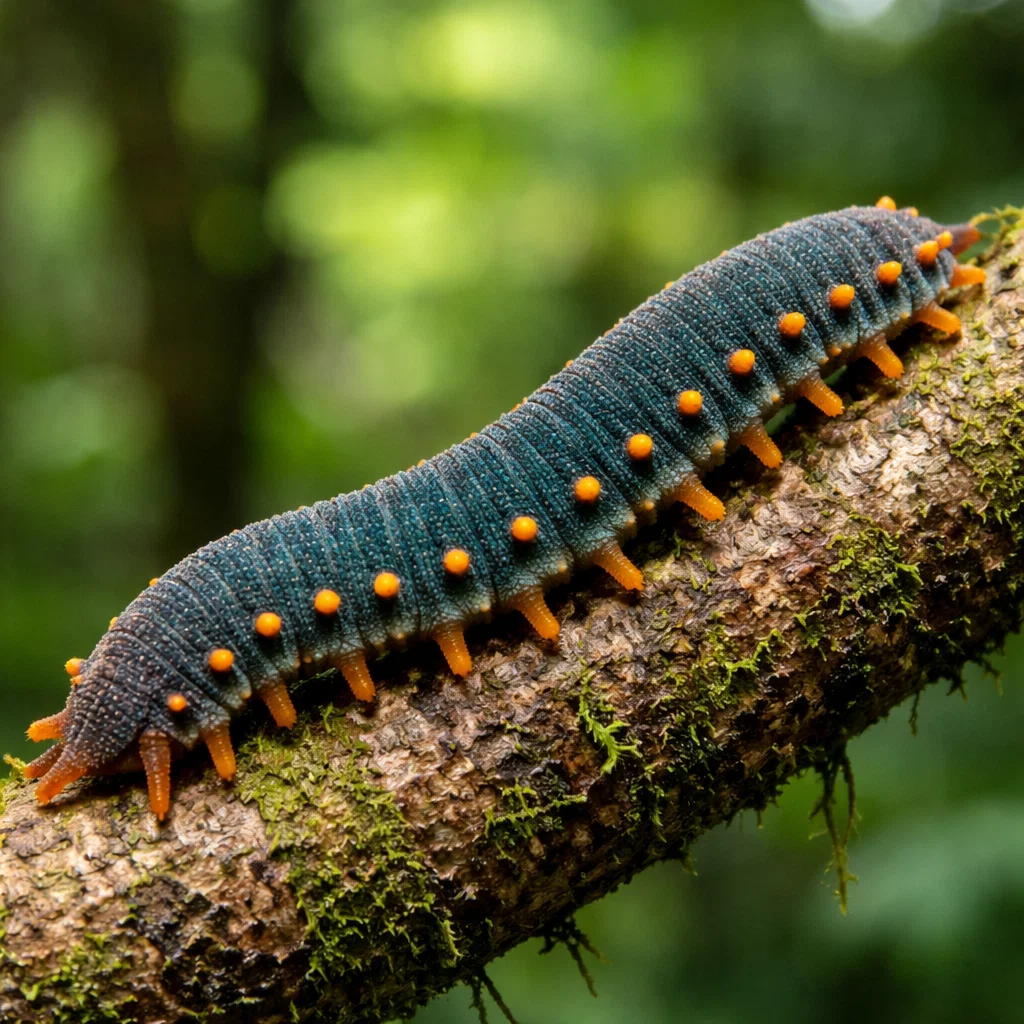
One of the most frequent questions we receive at Petnarianpets is: Are velvet worms considered living fossils? The answer is a definitive yes. When comparing the anatomy of Oroperipatus tiputini to fossils found in the Burgess Shale, the similarities are staggering. They possess a hydrostatic skeleton, meaning they use internal fluid pressure to maintain their shape and move their numerous pairs of unjointed legs, known as lobopods.
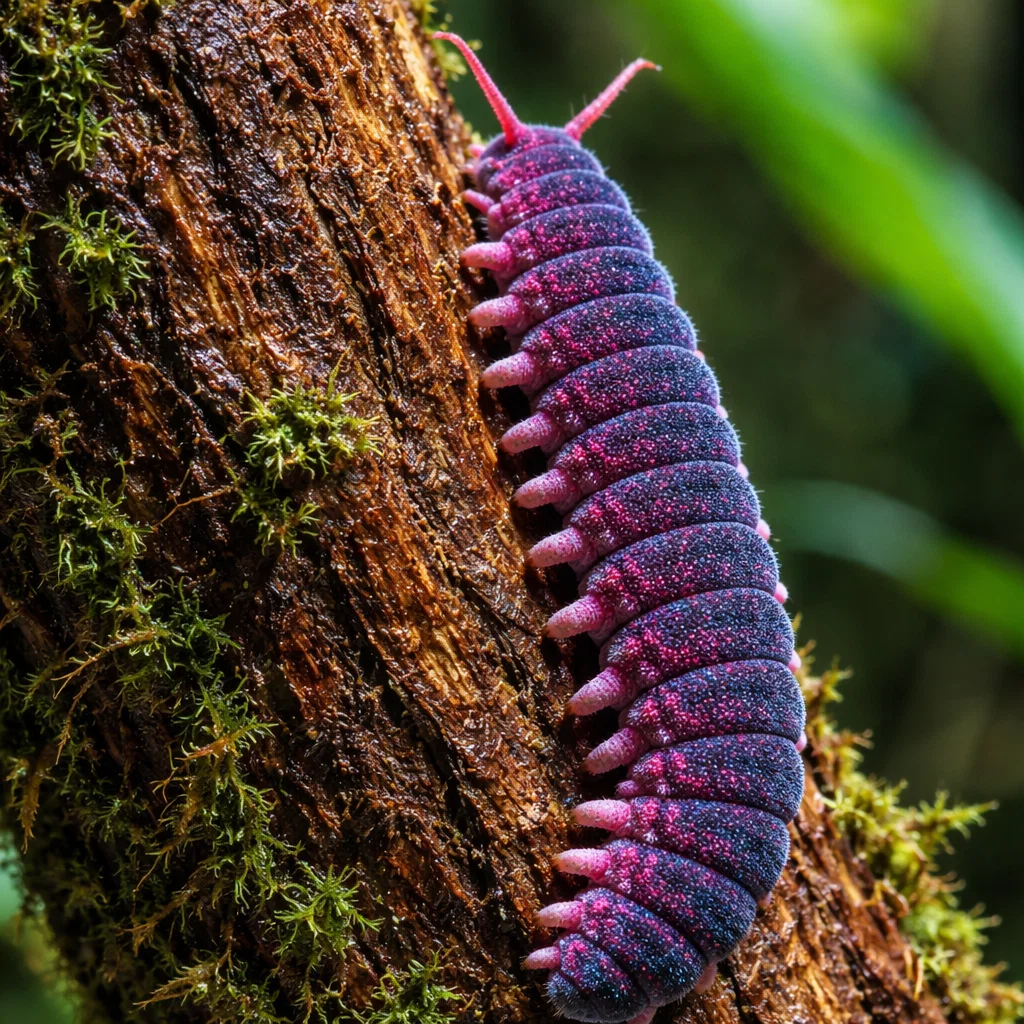
The skin of the Tiputini velvet worm is covered in millions of microscopic scales, which gives it a characteristic matte, “velvety” appearance. This is not merely an aesthetic choice by nature; the texture is highly hydrophobic, repelling water to ensure the animal can breathe through its tracheae even in the drenching humidity of the Amazon. Their color palette typically consists of deep browns, oranges, and subtle purples, allowing them to blend perfectly with the decaying organic matter of the forest floor—a classic example of Ecuadorian Amazon wildlife camouflage.
How Does Oroperipatus tiputini Catch Prey?
The hunting behavior of the Tiputini velvet worm is one of the most violent and sophisticated displays in the invertebrate world. Despite their slow movement and soft appearance, they are apex predators of the leaf litter. When a velvet worm detects the vibrations of a potential meal—such as a cricket or a small spider—it slowly approaches until it is within range.
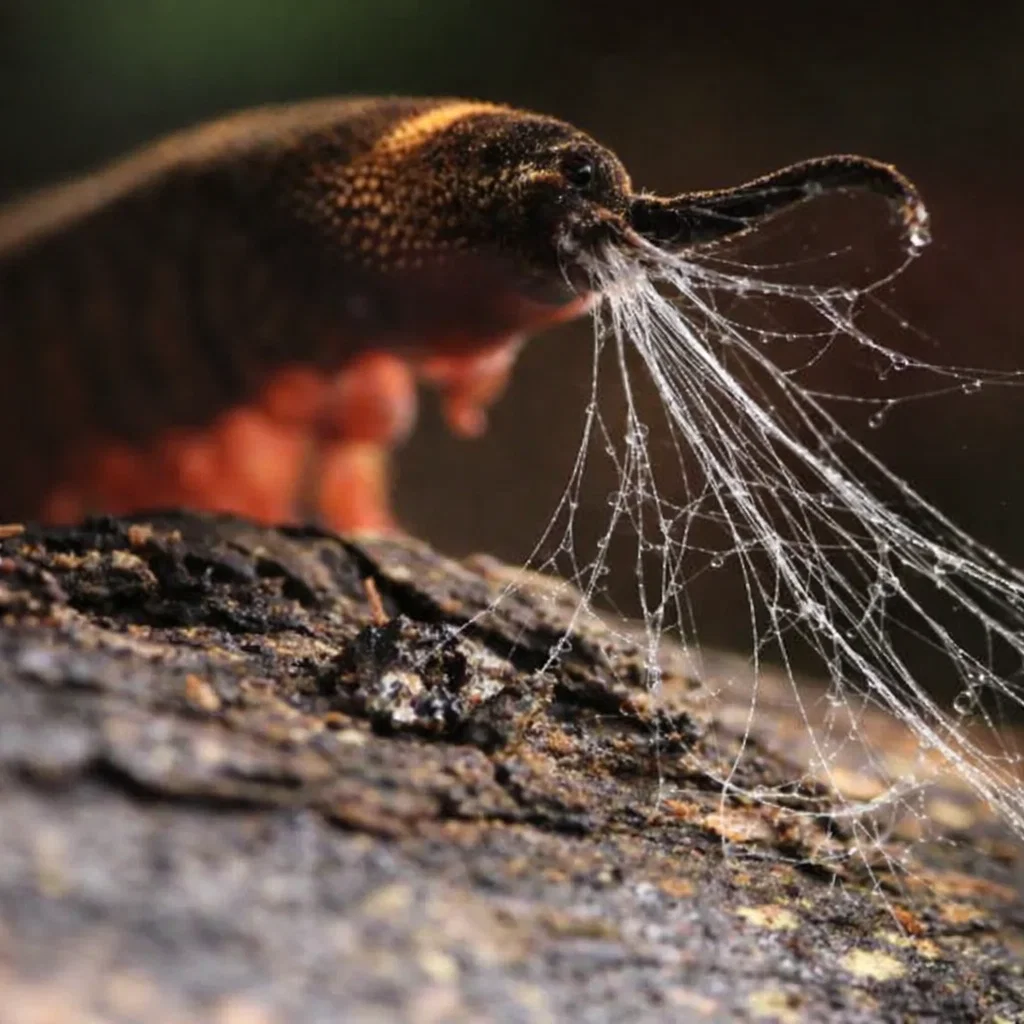
Then, it deploys its “superpower.” Located on either side of the head are oral papillae, which are essentially high-pressure slime cannons. In a fraction of a second, the worm ejects a protein-based liquid glue. As this liquid hits the air, it hardens into a sticky, tangled web that completely immobilizes the prey. This glue is so powerful that even insects much larger than the velvet worm find themselves trapped. Once the prey is secured, the worm approaches at a leisurely pace, uses its sickle-shaped jaws to puncture the insect’s exoskeleton, and injects digestive enzymes to liquefy the insides before slurping them up.
Environmental Vulnerability and Niche Specialists
The habitat requirements for the Onychophora Amazonia are incredibly specific. Unlike many other tropical invertebrates that can adapt to secondary growth or agricultural fringes, velvet worms are primary forest obligates. They require the complex layers of an undisturbed rainforest to survive. The leaf litter must be thick enough to maintain a constant 80-90% humidity level at the soil surface, as the worms cannot close their respiratory spiracles.
If the canopy is thinned by logging or road construction, the increased sunlight reaches the forest floor, drying out the leaf litter and essentially suffocating the velvet worms. This makes the Tiputini velvet worm facts vital for conservation efforts. They serve as “indicator species”—their presence or absence tells scientists exactly how healthy and intact the surrounding ecosystem really is.
Social Behavior and the Reproductive Cycle
The social life of velvet worms is surprisingly complex. While the Tiputini velvet worm is often found solitary, some related species have been observed living in hierarchical groups where they hunt together and follow a dominant female. In terms of reproduction, members of the Oroperipatus genus typically exhibit viviparity, meaning they give birth to live young rather than laying eggs.
The gestation period for these animals can be exceptionally long, sometimes lasting over a year. The young are born as miniature, translucent versions of the adults, fully formed and ready to hunt. Petnarianpets researchers have noted that while direct “parental care” in the sense of feeding the young hasn’t been widely documented in this specific new species, the young often stay within the mother’s territory for several weeks, benefiting from the protection of her established hunting grounds.
Differences Between Oroperipatus tiputini and Other Velvet Worms
When looking at the Differences between Oroperipatus tiputini and other velvet worms, scale and leg count are the primary visual cues. The Tiputini species tends to have a higher density of skin papillae, which makes it appear “fuzzier” than the more common Peripatus species found in Central America. Furthermore, the genetic sequencing of the Velvet worm new species 2024 shows a distinct lineage that has been isolated in the lowland Amazon for millions of years, diverging from the highland Andean species.
It is also important to distinguish between the two main families:
- Peripatidae: Found in tropical regions (like our Tiputini friend). They are usually larger and have more legs.
- Peripatopsidae: Found in the Southern Hemisphere, including Australia, New Zealand, and South Africa.
This brings us to the South Africa velvet worm discovery, where researchers recently identified Peripatopsis barnardi, a species thought to be extinct. This highlights a global trend: as our detection methods improve, we are finding that velvet worms are more diverse than we ever imagined, yet more threatened than ever before.
The Ethics of Owning a Velvet Worm
With the rise of “invert-keeping” as a hobby, searches for Velvet worm for sale or Tiputini velvet worm for sale have increased. At Petnarianpets, we must address the ethical and biological reality of keeping these animals. Velvet worms are notoriously difficult to keep in captivity. Their requirement for 100% humidity combined with high airflow (to prevent mold) is a delicate balance that most home setups fail to achieve.
Furthermore, almost all Velvet worms currently found in the trade are wild-caught. Taking these long-lived, slow-reproducing animals out of the Amazon to sit in a plastic box in a different climate is often a death sentence for the individual and a blow to the local population. We strongly discourage the purchase of wild-caught velvet worms and instead urge enthusiasts to support conservation programs that protect their natural Ecuadorian Amazon wildlife habitats.
Are Velvet Worms Dangerous to Humans?
A common fear regarding strange-looking invertebrates is: Are velvet worms dangerous? To humans, the answer is no. They have no venom that can affect a mammal, they cannot bite through human skin, and their slime—while incredibly sticky—is non-toxic. The only “danger” they pose is a messy cleanup if you happen to get their defensive slime on your clothes or skin.
To the insect world, however, they are terrifying. They represent an ancient predatory force that has perfected the art of the ambush. Understanding that they are harmless to us helps foster a sense of stewardship rather than fear. These are not pests; they are the “ancient guardians” of the forest floor, playing a vital role in controlling the populations of insects that break down leaf litter.
Frequently Asked Questions (FAQ)
What does the Tiputini velvet worm look like?
It is a soft-bodied, multi-legged invertebrate with a velvety texture. It typically displays earthy tones of orange, brown, and deep blue-grey. It has two prominent antennae and two smaller oral papillae used for shooting slime.
Where is Tiputini velvet worm specific habitat?
This species is endemic to the lowland primary rainforests of the Ecuadorian Amazon, specifically within the Yasuní Biosphere Reserve and around the Tiputini Biodiversity Station.
How rare is this species?
While they may be locally abundant in undisturbed forest, they are considered rare due to their extremely specific habitat requirements and their elusive, nocturnal nature. Any habitat disturbance can cause a local extinction.
What is its unique hunting behavior?
It uses “slime cannons” to shoot a fast-hardening adhesive at its prey from a distance. Once the prey is stuck, the worm uses its jaws to liquefy and consume the insect’s internal tissues.
Does it show parental care?
Most Oroperipatus species give birth to live young. While they don’t “raise” their young in the mammalian sense, the offspring often remain in the safety of the mother’s humid micro-habitat until they are large enough to venture out on their own.
Protecting the Ancient Wonders of the Amazon
The description of the Tiputini velvet worm facts in 2024 is more than just a new name in a textbook; it is a reminder of the depth and complexity of the Ecuadorian Amazon wildlife. As we continue to uncover the secrets of the Onychophora Amazonia, we are faced with the urgent need to protect the primary forests they call home.
At Petnarianpets, we believe that education is the first step toward conservation. By understanding the biology of Oroperipatus tiputini, from its hydrostatic skeleton to its high-pressure slime cannons, we can appreciate the incredible resilience of a lineage that has survived for half a billion years. Whether you are a scientist, a nature lover, or an enthusiast of “living fossils,” the velvet worm serves as a brilliant example of the hidden wonders waiting to be discovered in the leaf litter of our planet’s most ancient forests.
Stay wild, stay curious – only on PetNarianPets!
Join The Fun On Instagram, X, Pinterest and YouTube.
Wanna Say Something about animals ? Contact Us.