Discover the fascinating world of the Tawny Frogmouth. Learn to identify the unique Tawny Frogmouth call, master the secrets of Tawny Frogmouth camouflage, and find out how to care for a Tawny frogmouth baby in this ultimate guide.
Table of Contents
Australia is home to some of the world’s most unique wildlife, but few creatures capture the imagination quite like the Tawny Frogmouth. Often mistaken for a nocturnal bird of prey, this fascinating species is a master of mimicry, a devoted partner, and a silent observer of the Australian bush. Despite its widespread presence in both rural and urban landscapes, much of its life remains a mystery to the casual observer.
In this extensive guide, we will explore the intricate life of the Podargus strigoides, covering everything from its specialized hunting techniques to the secrets of its world-class disguise. Whether you are a dedicated birder or a curious resident wondering about the strange “stump” in your backyard, this article will provide everything you need to know about this iconic bird.
Evolution and Taxonomy
To understand this bird, we must first look at where it sits in the avian family tree. While it shares many visual characteristics with owls—such as large eyes and a nocturnal lifestyle—the Tawny Frogmouth is actually more closely related to nightjars and oilbirds. It belongs to the family Podargidae, a group of birds specifically adapted for a life of stillness and precision.1
The evolutionary history of the frogmouth suggests a lineage that diverged from other nocturnal birds millions of years ago. Their unique morphology, particularly the wide, frog-like gape that gives them their name, is a specialized tool for their specific diet. Unlike owls, which use powerful talons to snatch prey, the frogmouth relies almost entirely on its beak.2 This distinction is vital for researchers and enthusiasts alike, as it dictates how the bird interacts with its environment.
Is the Tawny Frogmouth an Owl?
One of the most persistent myths in Australian ornithology is that these birds are a type of owl. While they are often called “mopokes”—a name also shared by the Southern Boobook owl—they are not owls.3
There are several key physiological differences:
- Feet and Talons: Owls have powerful, curved talons designed for gripping and killing prey.4 Frogmouths have relatively weak, small feet that are better suited for perching than for combat.5
- The Eyes: While both have large eyes for night vision, an owl’s eyes face directly forward for binocular depth perception.6 A frogmouth’s eyes are positioned more to the sides of the head.
- The Beak: The beak of a frogmouth is much wider and flatter, resembling the mouth of a frog.7
- Activity: Owls are active hunters that fly through the night to track prey.8 Frogmouths are “sit-and-wait” predators, remaining motionless for hours until an insect or small vertebrate wanders too close.
Mastery of Stealth
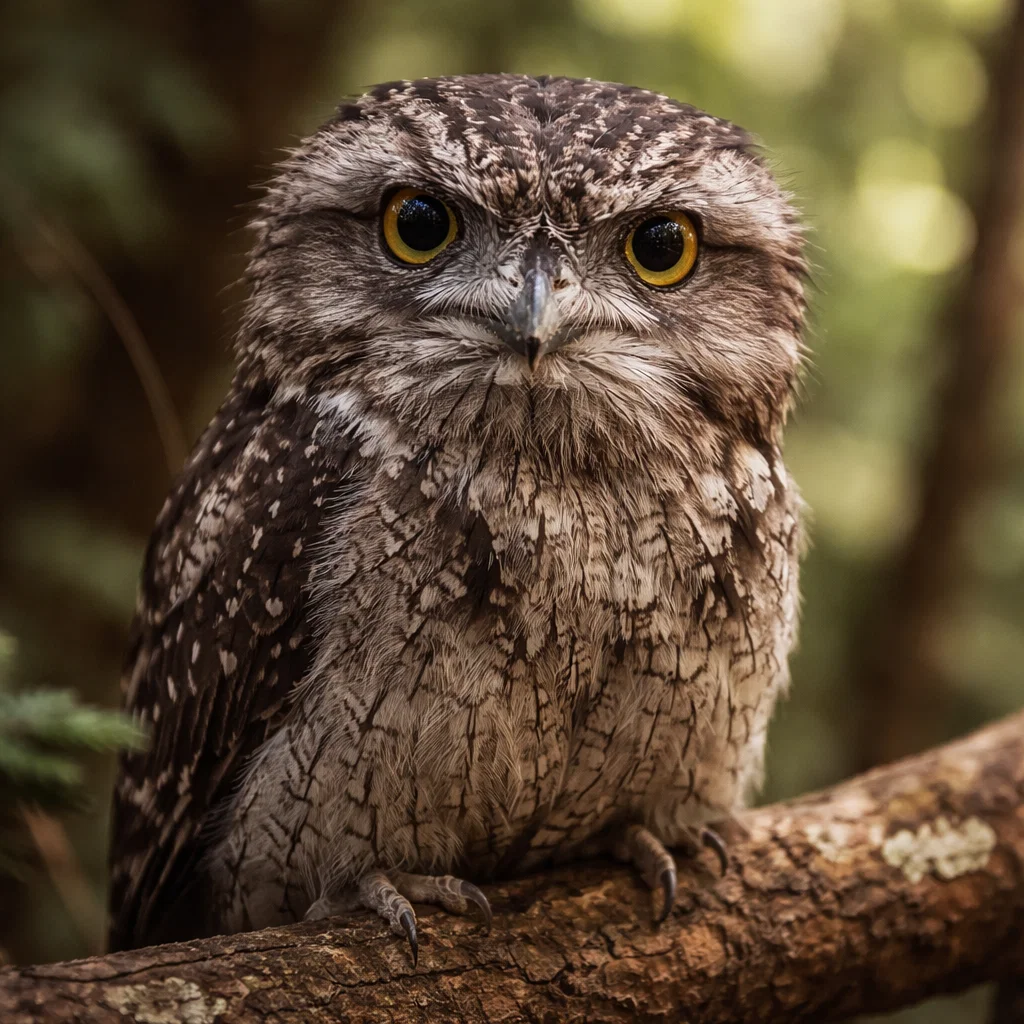
Survival in the Australian bush requires more than just speed; it requires the ability to disappear. This is where Tawny Frogmouth camouflage becomes one of the most impressive spectacles in the natural world. During the day, these birds do not hide in hollows like many other nocturnal species. Instead, they sit out in the open, perfectly still, on a tree branch.
Their plumage is a complex tapestry of greys, browns, and blacks, streaked and mottled to mimic the texture of rough eucalyptus bark or a broken branch. When a frogmouth senses a potential threat, it engages in a behavior known as “stumping.” It stretches its neck upward, narrows its eyes to thin slits, and points its beak toward the sky. In this posture, the bird becomes indistinguishable from a dead branch or a jagged stump.
This camouflage is so effective that humans and predators alike can walk directly beneath a perching bird without ever realizing it is there. This reliance on stillness is a high-stakes survival strategy. If the bird moves, the illusion is shattered. Consequently, they have developed an incredible level of patience and muscle control, remaining frozen for hours even in the face of wind or noise.
Understanding the Subtle Tawny Frogmouth Call
If you have ever spent a quiet night in the Australian suburbs or the outback, you may have heard a low, repetitive sound that feels more like a vibration than a traditional bird song. This is the Tawny Frogmouth call, a deep, rhythmic “oom-oom-oom” that can continue for several minutes at a time.9
Why do they call?
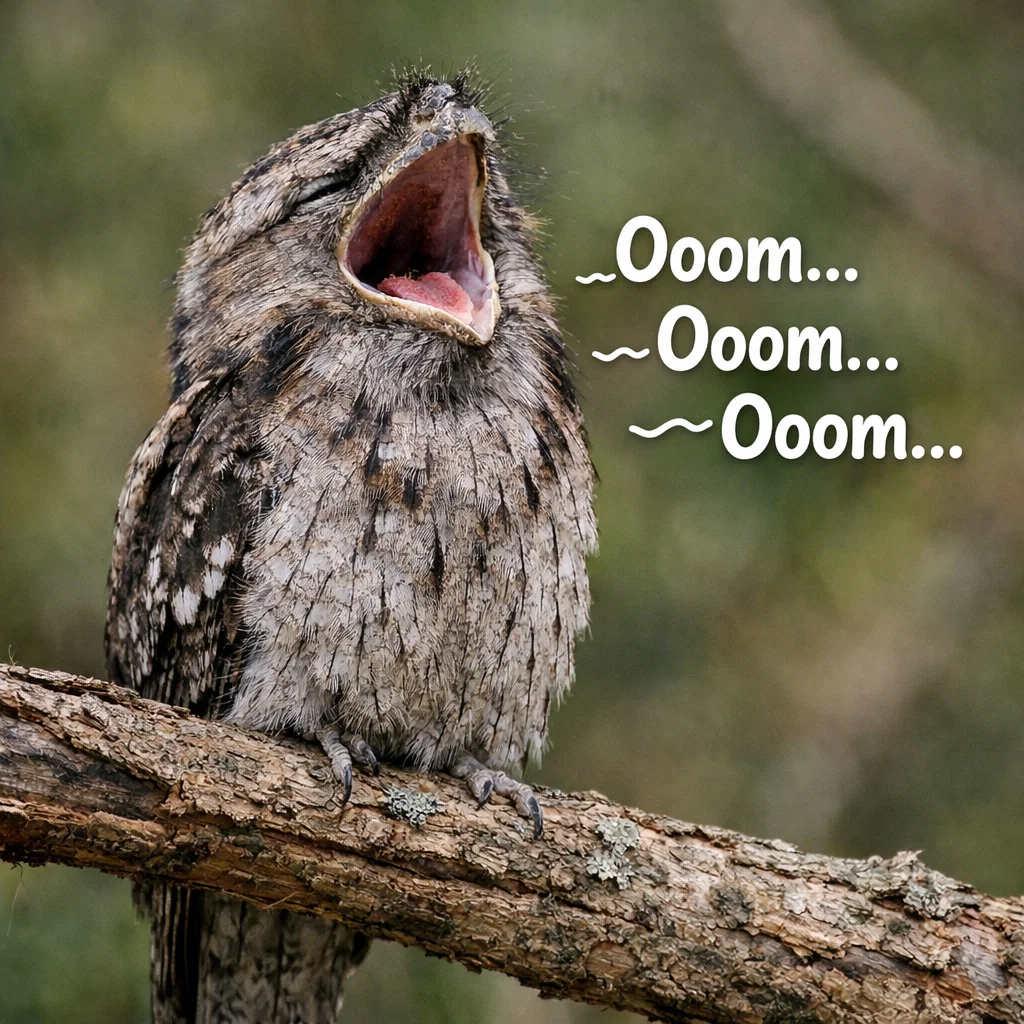
The primary purpose of the call is territorial communication and mate bonding. Because they are nocturnal and rely on staying hidden, vocalizations are the safest way to signal their presence to other birds without revealing their exact location to predators.
The sound is low-frequency, which allows it to travel through dense foliage and over long distances without losing its clarity.10 Interestingly, when people hear a loud, clear “mopoke” sound, they are usually hearing the Southern Boobook owl, not the frogmouth. The frogmouth’s vocalizations are much softer and more mechanical, often compared to the distant sound of a small engine or a soft grunting.
The Sit-and-Wait Predator
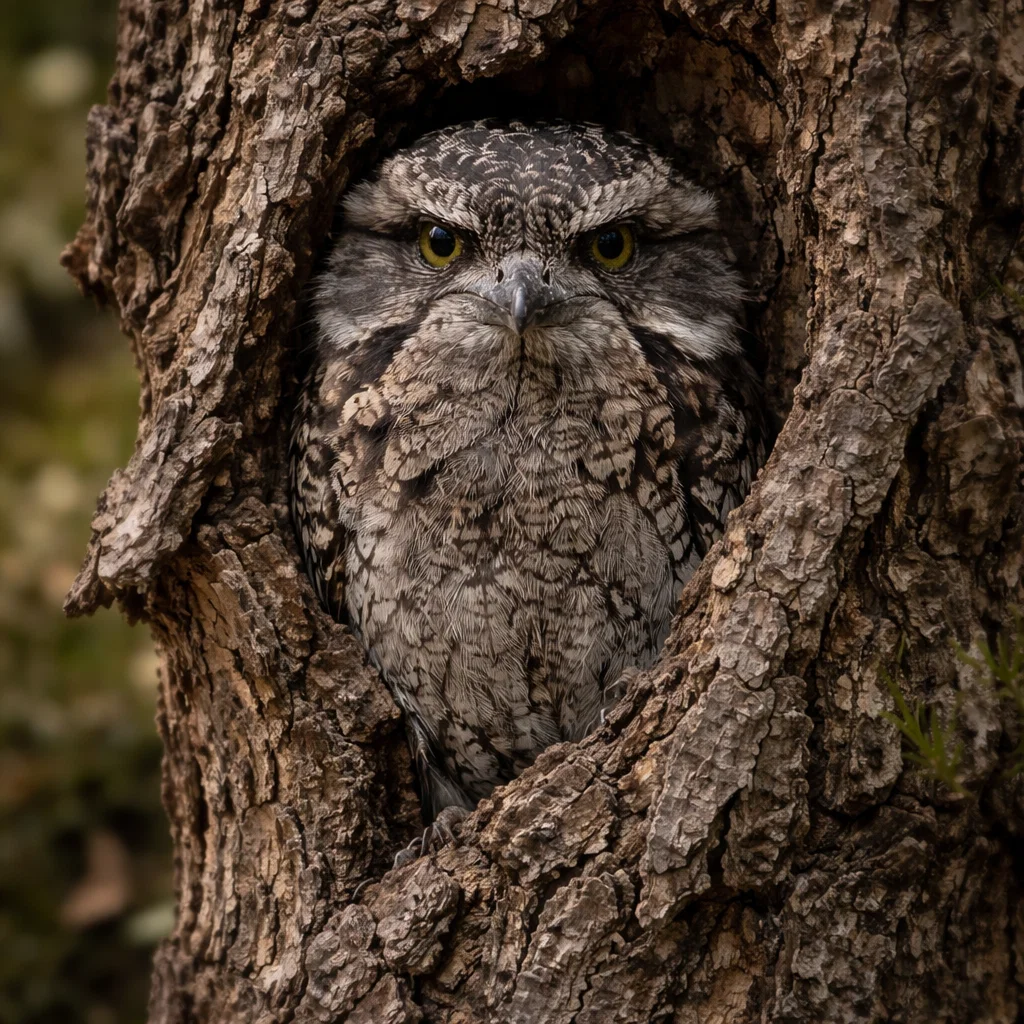
The foraging strategy of the frogmouth is a lesson in energy conservation. While owls hunt on the wing, the frogmouth prefers to let the food come to it. They typically perch on a low branch, a fence post, or even a letterbox, watching the ground with their keen nocturnal eyes.
Their diet is surprisingly diverse, consisting mainly of:
- Large nocturnal insects (moths, beetles, and grasshoppers)
- Spiders and centipedes
- Small mammals like mice
- Occasional frogs or small reptiles
When prey is spotted, the bird drops silently from its perch, scoops the item up in its wide beak, and returns to the branch. They often “tenderize” their meal by beating it against the branch before swallowing it whole. This method of hunting makes them highly susceptible to secondary poisoning from rodenticides, as they frequently consume mice that may have ingested bait in suburban areas.12
Family Life: From Nesting to the Tawny Frogmouth Baby
The social structure of these birds is remarkably stable. They are known to be monogamous, often staying with the same partner for life.13 Their nesting habits, however, leave something to be desired in terms of engineering. A frogmouth nest is typically a flimsy, flat platform of sticks placed in the fork of a horizontal branch.14
The Arrival of the Chick
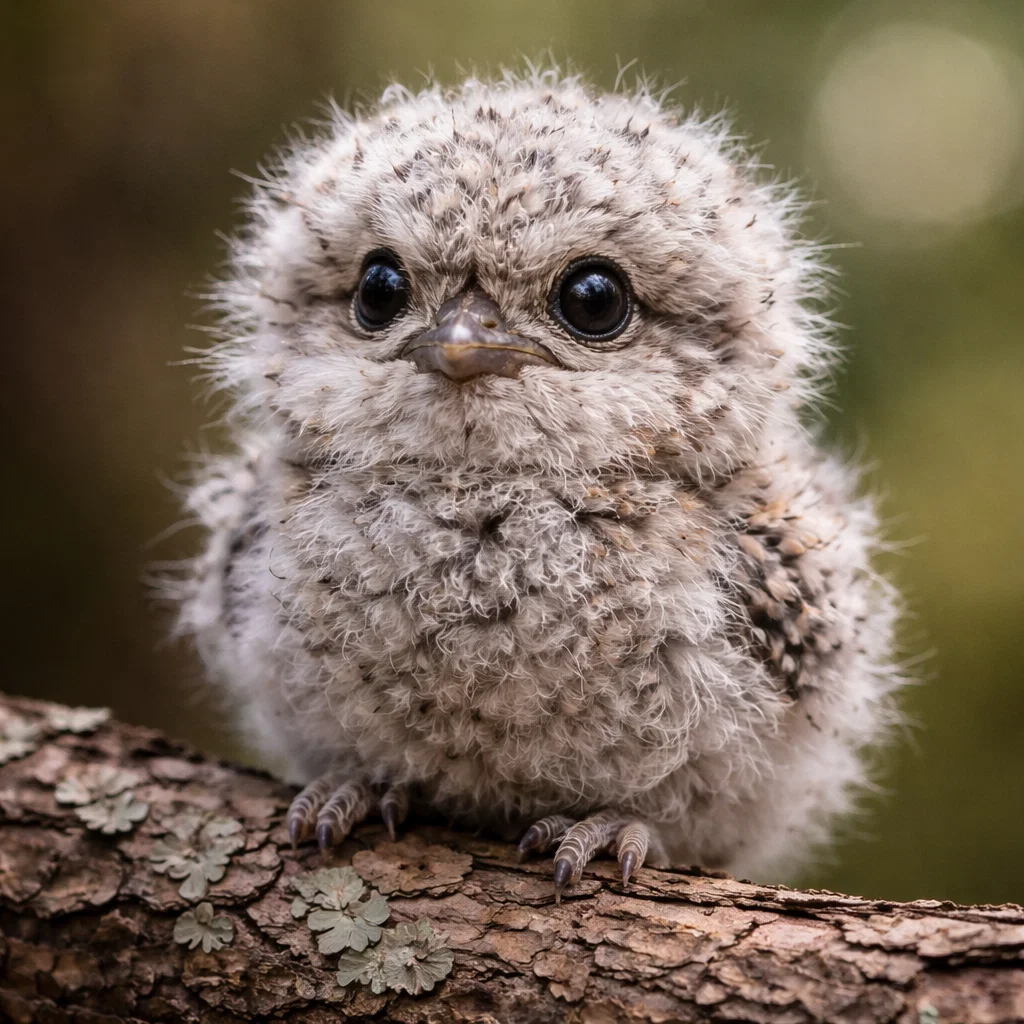
When a Tawny frogmouth baby hatches, it looks very different from its parents. The chicks are covered in a thick, white downy fluff that makes them resemble small cotton balls.15 This white plumage eventually gives way to the streaked grey feathers as they mature.
During the nesting period, both parents share the responsibilities. Usually, the male sits on the nest during the day (using his camouflage to protect the eggs), while the female takes over at night. This tag-team approach ensures that the nest is never left unguarded.
As the Tawny frogmouth baby grows, it begins to learn the “stumping” posture. It is a comical sight to see two or three fluffy white chicks attempting to look like dead sticks alongside their father. Within a few weeks, they become fledglings, eventually leaving the nest but often staying within the parents’ territory for several months to learn the finer points of hunting and camouflage.
| Developmental Stage | Characteristics |
| Hatchling | Covered in white down; completely dependent on parents. |
| Nestling | Developing pin feathers; begins to mimic adult posture. |
| Fledgling | Leaves the nest; plumage starts to show adult “bark” patterns. |
| Juvenile | Independent hunter; seeks out new territory or stays nearby. |
Common Misidentifications and Comparisons
Living in close proximity to humans often leads to confusion between the frogmouth and other common Australian birds.
Is a Tawny Frogmouth a Kookaburra?
Despite both being iconic Australian birds with large heads and prominent beaks, the two are entirely unrelated. A Kookaburra is a type of Kingfisher, active during the day (diurnal), and famous for its loud, laughing call.16 The frogmouth is nocturnal, silent, and has a much wider, flatter beak. They occupy completely different ecological niches; while the Kookaburra is a bold, aggressive hunter of snakes and lizards, the frogmouth is a cryptic, shy insectivore.
Are Frogmouths Aggressive?
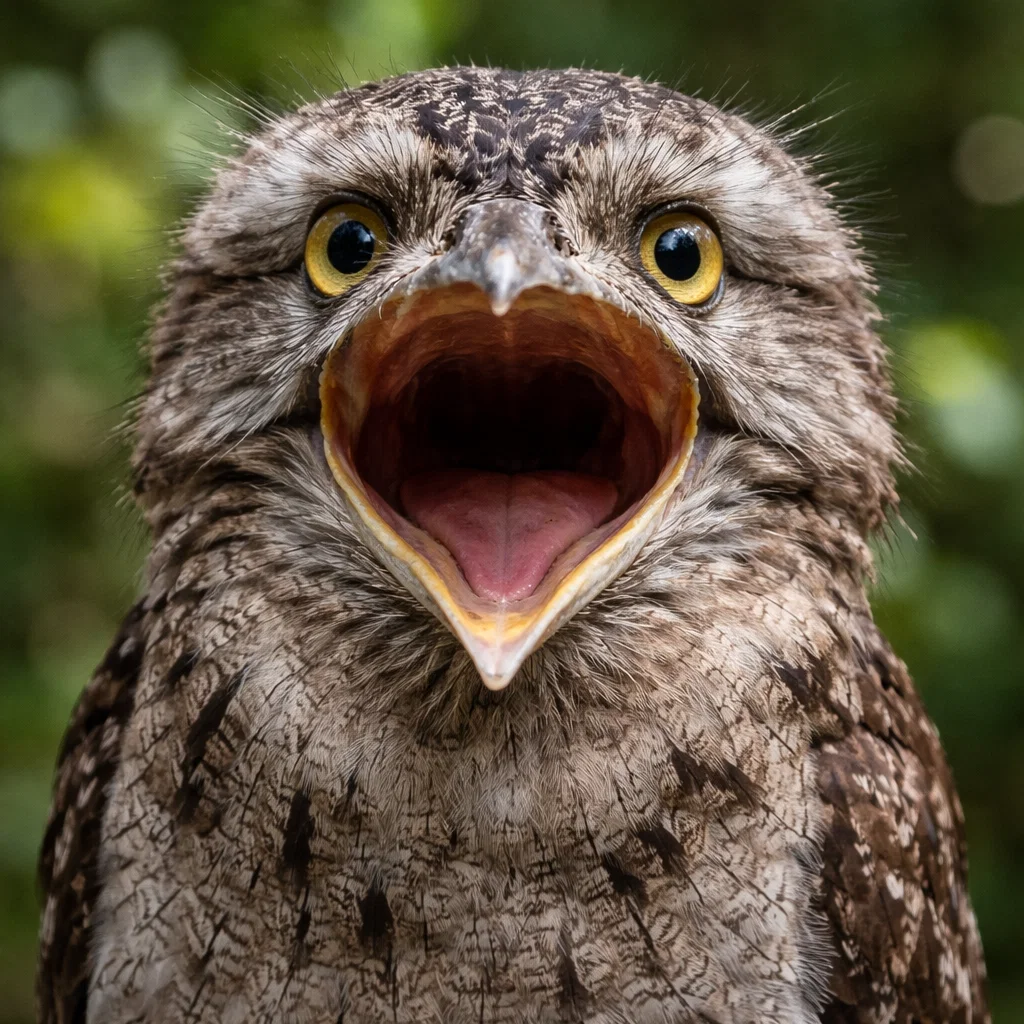
To humans, frogmouths are generally incredibly docile. Their primary defense is to hide, not to fight. However, if they feel cornered or if their nest is directly threatened, they can put on a frightening display. They will open their mouths wide, revealing a bright yellow interior, and hiss loudly while snapping their beaks. This is purely a bluff intended to scare off predators like cats or possums. They are not aggressive by nature and will always choose flight (or stillness) over a physical confrontation.
Habitat and Distribution Across Australia
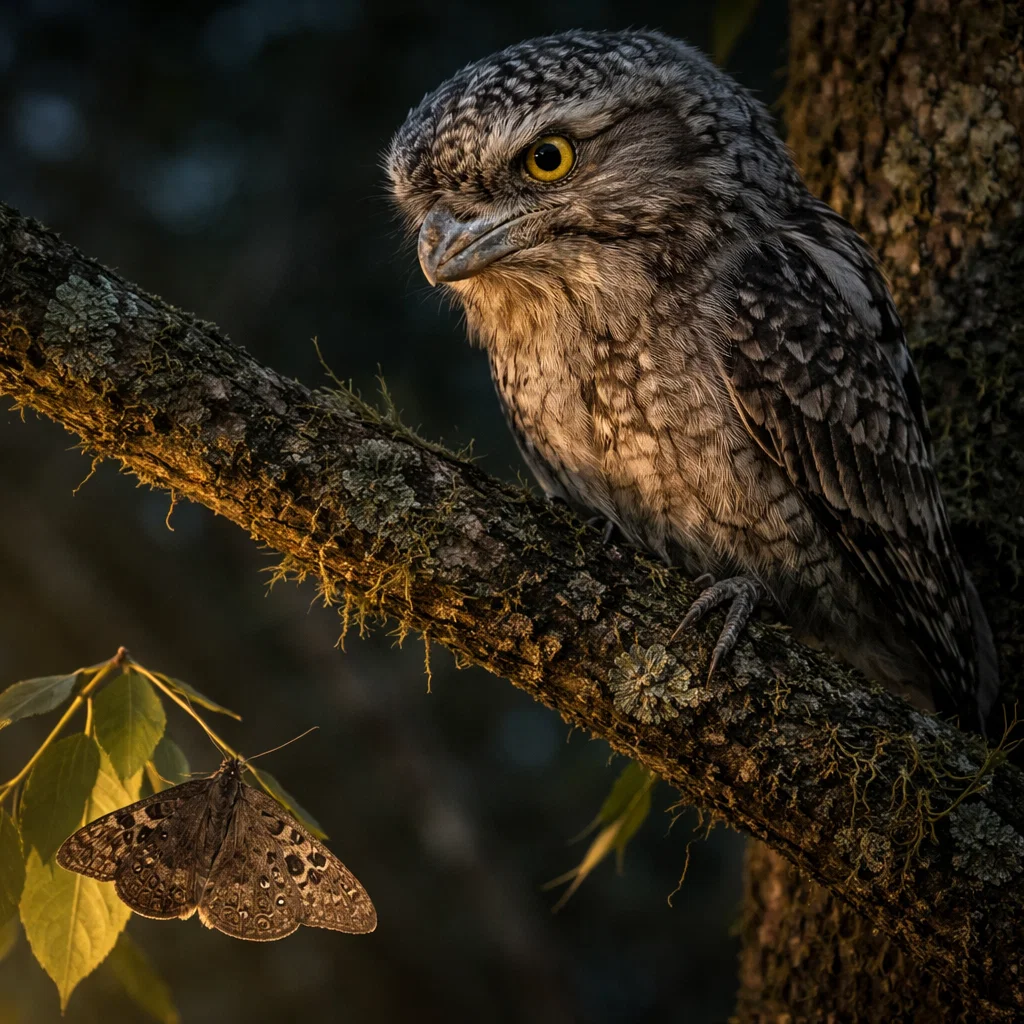
The Tawny Frogmouth is a highly adaptable bird, which explains its presence across almost the entire Australian mainland and Tasmania.17 They are found in a variety of environments, including:
- Open woodlands and forests
- Acacia scrublands
- Parks and suburban gardens
- Arid regions (though they prefer areas with some tree cover)
They avoid dense rainforests and treeless deserts, as they require trees for their camouflage-based survival.18 In urban environments, they have become remarkably comfortable. They are often found in backyard fruit trees or perched on power lines. This adaptability is a testament to their resilience, though it does bring them into contact with modern threats like cars and domestic pets.
What Does It Mean if You See a Tawny Frogmouth?
In many cultures, nocturnal birds are seen as messengers or omens.19 Because the frogmouth is so good at hiding, seeing one is often considered a rare and special event.
- Patience and Stillness: In a spiritual sense, the frogmouth is often seen as a symbol of patience. Because they spend their days in a meditative-like state of stillness, they remind us to slow down and observe our surroundings before acting.
- Hidden Truths: Their mastery of camouflage suggests that things are not always as they seem. Seeing one might be interpreted as a sign to look closer at a situation in your life—there may be something “hidden in plain sight.”
- Aboriginal Culture: In various Indigenous Australian cultures, birds are often seen as ancestral spirits or totems.20 The frogmouth appears in several Dreamtime stories, often depicted as a wise but quiet figure.21
Finding a frogmouth in your garden is generally considered a sign of a healthy local ecosystem. It means there are enough large insects and safe nesting sites to support a top-tier nocturnal predator.
Modern Threats and Conservation Efforts
While the Tawny Frogmouth is currently listed as “Least Concern” by conservation bodies, they face significant challenges in the modern world.22 Their reliance on camouflage, while effective against natural predators, is a disadvantage against human-made threats.
Road Accidents
One of the biggest killers of frogmouths is road traffic. Because they hunt insects that are attracted to car headlights, they often fly low across roads and are struck by vehicles.23 Unlike many birds that fly away when they see a car, a frogmouth’s instinct may be to freeze, which is fatal in the middle of a highway.
Domestic Pets
Cats and dogs pose a significant threat, especially to fledglings.24 When a Tawny frogmouth baby first leaves the nest, it often spends time on low branches or on the ground as it strengthens its wings. This makes them easy prey for roaming domestic cats.
How You Can Help
- Reduce Pesticide Use: Avoid using strong rat poisons or insecticides, as these can travel up the food chain and kill the birds that eat the poisoned pests.
- Keep Pets Indoors: Keeping cats indoors at night saves countless native birds.
- Provide Habitat: Planting native trees and shrubs provides the necessary “stumps” for these birds to hide on during the day.
Observing the Master of Disguise Responsibly
If you are lucky enough to have a frogmouth living nearby, it is important to observe them without causing stress.
- Keep your distance: If the bird is in its “stump” posture, it knows you are there and is trying to hide. Getting too close can force it to break cover, wasting its energy and potentially exposing it to predators.
- Avoid bright lights: If observing them at night, use a dim torch with a red filter. Bright white light can temporarily blind them, making it impossible for them to hunt or navigate.
- Listen, don’t look: Sometimes the best way to enjoy a frogmouth is simply to sit on your porch and listen for the rhythmic Tawny Frogmouth call echoing through the trees.
Frequently Asked Questions
Why is their mouth so big?
The “frog mouth” is an adaptation for catching large prey. The wide gape acts like a net, allowing them to snap up large moths and beetles with high precision.
How long do they live?
In the wild, they can live for up to 10 to 15 years, provided they avoid predators and road accidents.25
Do they migrate?
No, they are generally sedentary. Once a pair establishes a territory, they will often stay in that same small area for their entire lives.
Can they see in color?
Like most nocturnal birds, they have a high density of rod cells in their eyes for low-light vision, but they likely have limited color perception compared to diurnal birds.
A Bird Worth Protecting
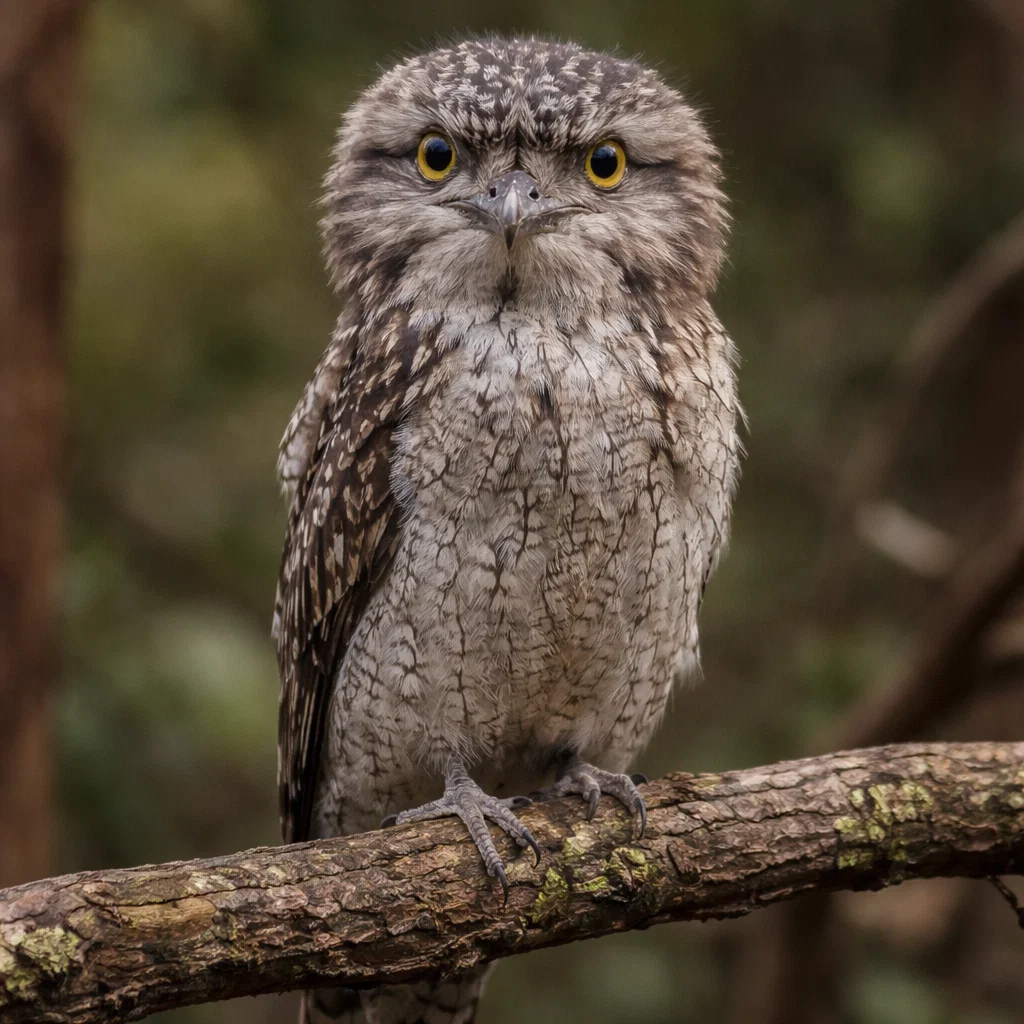
The Tawny Frogmouth is a true Australian icon. It represents the quiet, resilient beauty of the bush. From its incredible Tawny Frogmouth camouflage that defies the laws of visibility to the soft, comforting rhythm of the Tawny Frogmouth call, this bird is a reminder of the wonders that exist just outside our windows after the sun goes down.
By understanding that they are not aggressive, not owls, and certainly not kookaburras, we can better appreciate them for exactly what they are: unique, evolutionary masterpieces. Whether you are watching a fluffy Tawny frogmouth baby grow or marveling at an adult’s ability to turn into wood, these birds deserve our respect and protection.
Stay wild, stay curious – only on PetNarianPets!
Join The Fun On Instagram, X, Pinterest and YouTube.
Wanna Say Something about animals ? Contact Us.