
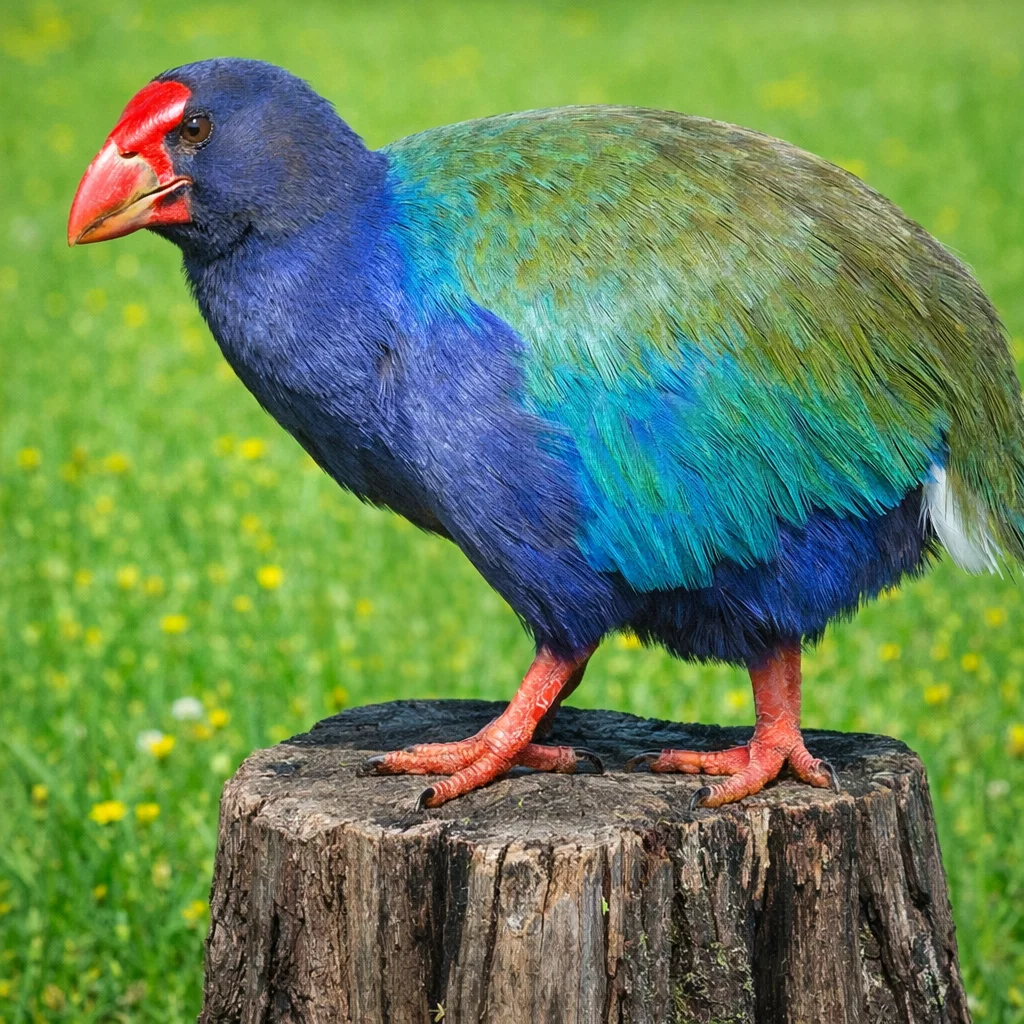
The natural history of New Zealand is defined by a unique evolutionary laboratory that favored the development of some of the world’s most specialized avian species. Among the most celebrated of these organisms is the Takahe bird (Porphyrio hochstetteri), a prehistoric-looking marvel that serves as a living testament to the resilience of island-bound wildlife.
Table of Contents
Historically, the presence of New Zealand flightless birds was a hallmark of an ecosystem devoid of terrestrial mammalian predators, allowing for the evolution of heavy-bodied, ground-dwelling rails that occupied niches typically held by mammals in other parts of the world.
The South Island Takahe is not merely a bird; it is a “Lazarus species,” a term used in biological sciences to describe a taxon that disappears from the fossil or observational record only to be rediscovered in a remote refugium. For decades, the global scientific community mourned the loss of this iridescent giant, believing it had succumbed to the pressures of habitat loss and introduced predators.
However, its dramatic reappearance in the mid-20th century sparked one of the most intensive and successful conservation sagas in modern history. At PetNarianPets, we explore the intricate biology, behavioral ecology, and survival of this extraordinary rail.
| Field | Data Detail |
| Classification | Kingdom: Animalia, Phylum: Chordata, Class: Aves, Order: Gruiformes, Family: Rallidae |
| Scientific Name | Porphyrio hochstetteri |
| Habitat | Alpine tussock grasslands and sub-alpine beech forests |
| Diet | Herbivorous: Tussock leaf bases, fern rhizomes, and opportunistic insects |
| Lifespan | 16–18 years in the wild; up to 22 years in managed sanctuaries |
| Superpower” or Special Feature | Vestigial wing spurs and a beak capable of 50kg of pressure |
| Natural Predator | Historically none; currently stoats, ferrets, and feral cats |
| Natural Prey | Insects (beetles, wētā, and moths) and forest invertebrates |
Etymology and Cultural Context: The Takahe Meaning
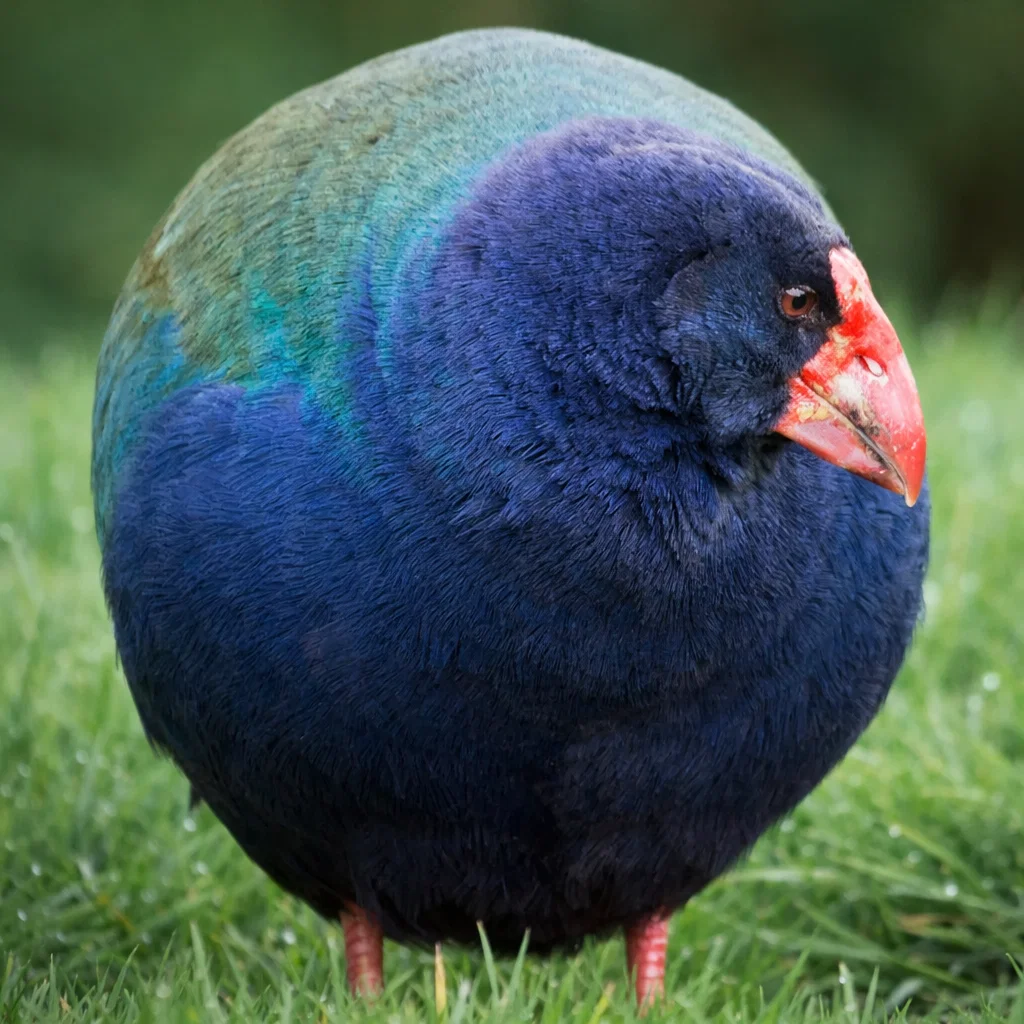
To understand the cultural and linguistic significance of this bird, one must look to the indigenous Te Reo Māori language. The Takahe meaning is often interpreted as “to stamp” or “to trample,” a reference to the bird’s heavy, deliberate gait as it moves through the dense snow tussock of the Southern Alps. For the Māori people, the bird was a “taonga” (treasure), valued both as a source of food and for its vibrant feathers, which were used in traditional weaving.
The Takahe pronunciation typically follows the Māori phonetic structure: tah-kah-hee (/tɑːkəhiː/). Historically, the Māori were well aware of the bird’s existence in the remote reaches of the South Island, even as early European settlers struggled to find evidence of its survival. The bird’s elusive nature led to it being nicknamed the “blue goose” by early high-country explorers who occasionally caught glimpses of its massive, blue-green form disappearing into the alpine mists.
Why is the Takahe flightless?
The phenomenon of flightlessness in New Zealand’s avifauna is a classic example of “island syndrome.” For millions of years, the island was separated from the Gondwanan supercontinent, creating a sanctuary where the only predators were other birds, such as the Haast’s eagle. In this environment, the high metabolic cost of maintaining flight muscles and large wings became an evolutionary disadvantage.
The Takahe bird evolved from a flying ancestor—likely a proto-swamphen that arrived from Australia—that found an abundance of food on the ground. Over time, its body mass increased, and its wings became vestigial, serving only as balance aids and tools for social signaling.
This transition allowed the bird to develop a large, robust digestive system capable of processing the tough, fibrous tussock grasses of the high country. Today, the South Island Takahe stands as the largest living member of the Rallidae family, a giant among rails that has traded the sky for the security of the mountain floor.
Physical Characteristics and Takahē Size
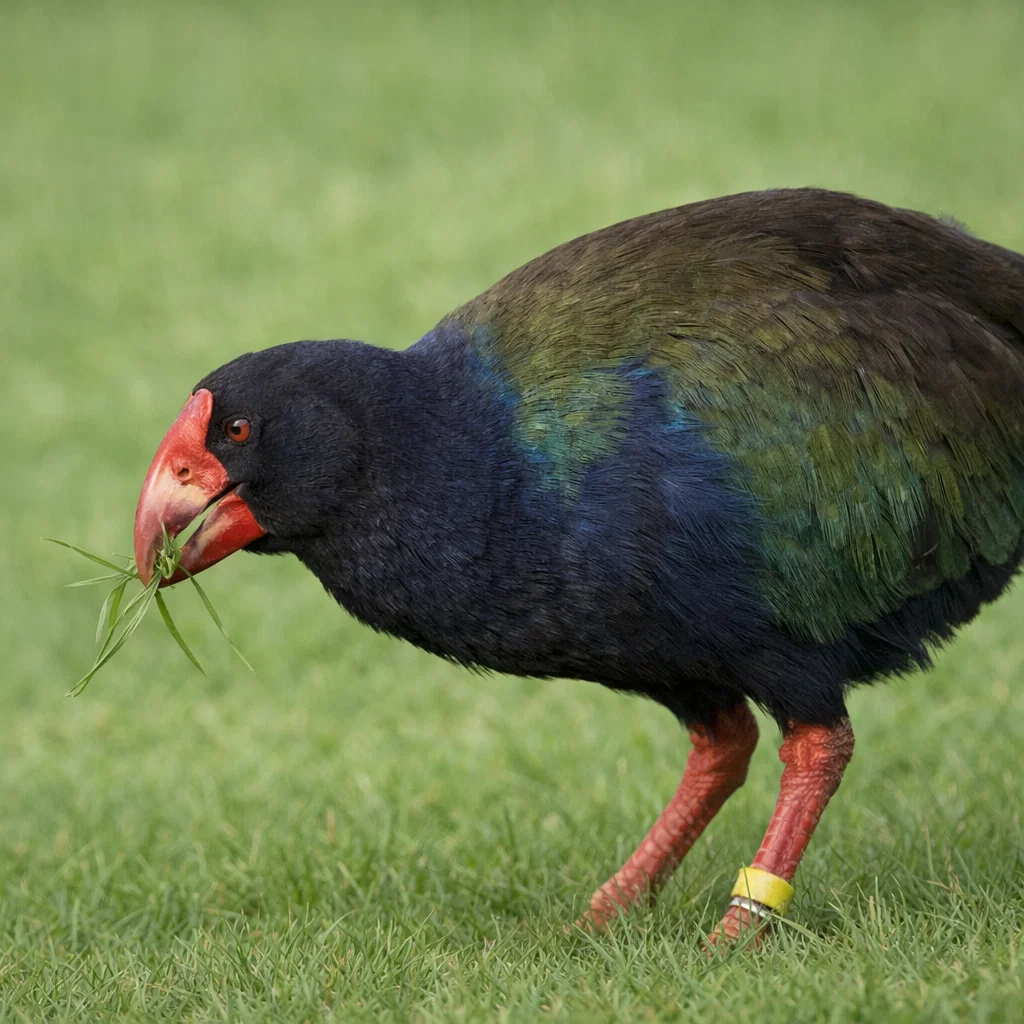
When observing the South Island Takahe, the most striking feature is its massive, high-arched crimson beak. This beak is not merely decorative; it is a powerful tool designed to strip the outer layers of tussock grass to reach the sugary, nutrient-dense leaf bases. The Takahē size is impressive for a rail, with adults standing approximately 50 centimeters tall and reaching lengths of up to 63 centimeters.
The weight of an adult bird typically ranges between 2.3 and 3.8 kilograms, making them roughly double the size of their more common relative, the Pūkeko. Their plumage is a masterclass in structural coloration, featuring deep indigo blue on the head and neck, transitioning into a shimmering iridescent emerald and olive green across the back and wings. This coloration provides a surprisingly effective camouflage against the varied greens and shadows of the alpine grasslands.
Morphology of the Takahe Egg and Breeding Cycle
The reproductive strategy of the Takahe bird is characterized by high parental investment and a low birth rate, a common trait in long-lived island endemics. They are monogamous and typically form lifelong pair bonds, often defending large territories that can span up to 100 hectares depending on food availability.
The Takahe egg is usually laid in a clutch of one to three, though two is the most common number. These eggs are a pale buff or cream color, speckled with brown and purple spots, and are roughly the size of a large chicken egg. Both parents share the duties of incubation, which lasts approximately 30 days. Interestingly, in many cases, only one chick from a clutch survives to fledging in the wild, which has led conservationists at PetNarianPets to adopt “nest management” techniques, such as removing a surplus egg to be raised in captivity to maximize the species’ growth rate.
Dietary Specialization: The Takahē Diet
The survival of this species is intrinsically linked to its specialized foraging mechanics. The Takahē diet is almost exclusively herbivorous, focused on the alpine snow tussocks (Chionochloa species). These birds use their powerful beaks to grip the base of a tussock plant and pull, effectively “harvesting” the plant to reach the succulent white base.
In addition to tussock, they consume:
- Fern Rhizomes: During the harsh winter months when snow covers the grasslands, they retreat to the sub-alpine beech forests to dig for starchy roots and rhizomes.
- Tussock Seeds: When the grasses mast (produce seeds), the birds shift their focus to these high-energy food sources.
- Invertebrates: While primarily plant-eaters, they are opportunistic and will consume large insects like wētā and beetles to supplement their protein intake, especially during the chick-rearing season.
Because their diet is so high in fiber and relatively low in nutrients, they must eat almost continuously. A single adult can produce up to nine meters of fibrous droppings in a single day—a biological curiosity that highlights the intensity of their metabolic process.
The Comparative Analysis: Takahe vs Pūkeko
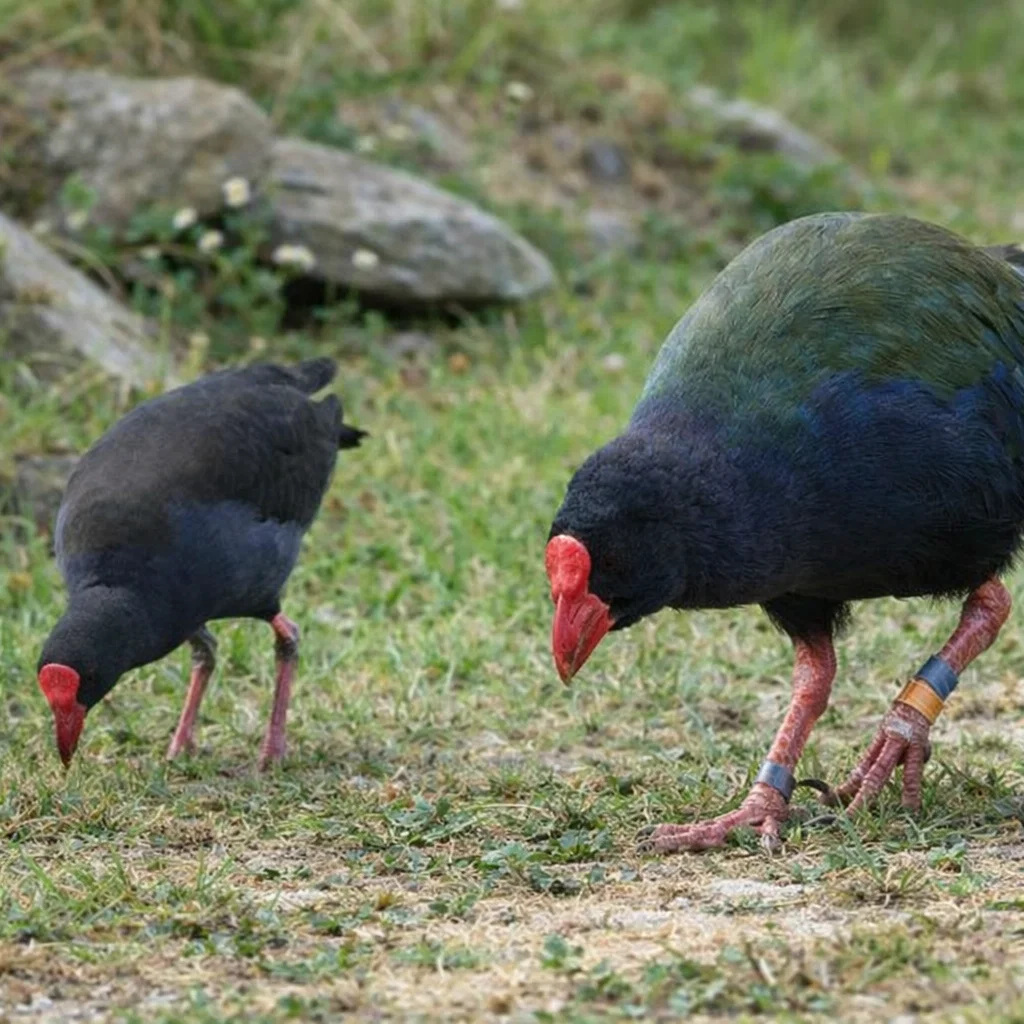
A common point of confusion for visitors to New Zealand is the distinction between the rare Takahe and the ubiquitous Pūkeko (Porphyrio melanotus). While both are members of the swamphen group and share a similar blue and red color palette, the Takahe vs Pūkeko comparison reveals two very different evolutionary paths.
- Flight Capability: The Pūkeko is a strong flier and a highly adaptable colonist that arrived in New Zealand much more recently. The Takahe is completely flightless and represents an ancient lineage.
- Size and Stature: The Takahe is significantly larger and “chunkier,” with a much heavier beak and shorter, thicker legs. The Pūkeko has long, thin toes and a more slender profile.
- Coloration: While the Pūkeko is primarily black and deep blue, the Takahe features distinct green and turquoise feathers on its back and wings.
- Habitat: Pūkeko are commonly found in wetlands, roadside ditches, and urban parks. Takahe are specialists of the remote alpine and managed island sanctuaries.
Historical Narrative: Are Takahe extinct?
For nearly 50 years, the answer to the question “Are Takahe extinct?” was a resounding “yes.” Following the collection of four specimens in the late 19th century, the bird vanished. It was officially declared extinct in 1898. However, one man remained unconvinced. Dr. Geoffrey Orbell, an Invercargill-based physician and amateur ornithologist, spent years studying maps and tracking rumors of strange bird calls in the Fiordland wilderness.
On November 20, 1948, Orbell and his team trekked into the Murchison Mountains. Near a high-altitude lake—now known as Lake Orbell—they spotted a pair of large, blue-green birds. The South Island Takahe had been rediscovered. This moment is often cited as one of the greatest ornithological finds of the 20th century, proving that even in a world dominated by human expansion, nature can still hide its most precious treasures in the shadows of the mountains.
Takahe Conservation Efforts and Population
Since the 1948 rediscovery, the Department of Conservation (DOC) has managed one of the world’s most sophisticated recovery programs. The Takahe conservation efforts and population data show a species on a slow but steady path to recovery. From a low point of just over 100 individuals in the early 1980s, the population has grown to approximately 528 birds as of 2024.
The recovery strategy involves several key pillars:
- Predator Control: Intensive trapping of stoats and ferrets in the Murchison Mountains.
- Island Sanctuaries: Establishing “insurance populations” on predator-free islands like Kapiti, Mana, and Tiritiri Matangi.
- Captive Breeding: The Burwood Takahē Centre serves as a nursery where chicks are raised—historically using hand puppets to prevent human imprinting—before being released into the wild.
- Wild Reintroductions: In recent years, birds have been released back into the Kahurangi National Park and the Greenstone Valley, successfully establishing new wild populations outside of their Fiordland stronghold.
Where You can see Takahe in New Zealand
For those wondering where to see Takahe in New Zealand, the species is now accessible thanks to the “ambassador” birds kept in public sanctuaries. While the wild population in the Murchison Mountains is strictly off-limits to the public to protect the fragile habitat, several sites offer guaranteed sightings.
- Zealandia (Wellington): This world-class ecosanctuary is home to several pairs that roam freely within the protected valley.
- Auckland Zoo: A primary site for those in the North Island to view the birds up close.
- Te Anau Bird Sanctuary: Located on the shores of Lake Te Anau, this sanctuary provides a vital public connection to the birds and is free to visit.
- Orokonui Ecosanctuary (Dunedin): A predator-free “mainland island” where Takahe can be seen in a natural forest and grassland setting.
- Tiritiri Matangi Island: An island sanctuary near Auckland where the birds live alongside other rare species like the Kōkako and Saddleback.
Frequently Asked Questions (FAQ)
Is the Takahe extinct?
No, the Takahe is not extinct. While it was believed to be extinct for 50 years, it was famously rediscovered in 1948 by Dr. Geoffrey Orbell in the Murchison Mountains. It is currently listed as “Nationally Vulnerable” but is increasing in number.
What is the difference between a Takahe and a Pūkeko?
The Takahe is much larger, flightless, and has iridescent green/blue feathers with a very heavy red beak. The Pūkeko is smaller, capable of flight, and has a more slender build with primarily black and indigo plumage.
Where do Takahe live?
Wild populations live in the alpine tussock grasslands and beech forests of the South Island, specifically in Fiordland and Kahurangi National Park. Managed populations also live on several predator-free offshore islands.
How many Takahe are left in the world?
As of 2024, the total population is estimated to be approximately 528 individuals, with a growth rate of about 8% per year thanks to intensive conservation efforts.
What do Takahe eat?
They are primarily herbivorous, eating the succulent bases of snow tussock and sedge plants. They also eat fern roots and occasionally supplement their diet with insects like wētā and beetles.
Our Take on Takahe Bird
The Future of the South Island Takahe
The story of the Takahe bird is one of hope and scientific dedication. As a flagship for New Zealand flightless birds, its journey from the brink of oblivion to its current status as a thriving conservation success story is unparalleled. While the species remains vulnerable to climate change and the persistent threat of invasive predators, the expansion of its range into new wild sites like the Greenstone Valley suggests a bright future. At PetNarianPets, we believe that the continued protection of the alpine “Lost World” of the South Island Takahe is essential for maintaining the biological heritage of New Zealand for generations to come.
Stay wild, stay curious – only on PetNarianPets!
Join The Fun On Instagram, X, Pinterest and YouTube.
Wanna Say Something about animals ? Contact Us.