[WATCH: The Real-Life Greater Roadrunner in Action]
(Video Placeholder: In this Petnarianpets exclusive, Witness how this desert icon survives the harsh North American landscape.)
Table of Contents
Introduction to the Desert’s Ground Cuckoo
When one thinks of the American Southwest, a few iconic images immediately come to mind: towering saguaro cacti, sun-bleached canyons, and the unmistakable silhouette of a bird streaking across the horizon. The Greater Roadrunner (Geococcyx californianus) is perhaps one of the most famous avian species in the world, though much of its fame is rooted in the world of animation. Beyond the “beep-beep” of the Road Runner cartoon, lies a highly sophisticated, intelligent, and brutal predator that has mastered one of the most inhospitable environments on Earth.
At Petnarianpets, we aim to separate the myth from the biological reality. While the Road Runner Looney Tunes character is a symbol of cleverness and speed, the Road Runner real bird is a terrestrial cuckoo that has traded the typical life in the canopy for a life of high-speed chases on the desert floor. This transition from air to ground has led to a series of remarkable evolutionary adaptations that make the Roadrunner bird a marvel of natural engineering. From its specialized feet to its ability to take down venomous reptiles, the story of this bird is one of extreme survival and predatory precision.
Understanding the Greater Roadrunner requires a deep dive into the ecology of the scrublands and deserts of North America. These birds are not merely fast runners; they are the “apex predators” of the undergrowth, occupying a niche that few other birds can fill. In this comprehensive guide, we will explore everything from their unique vocalizations to their incredible metabolic tricks for surviving freezing desert nights and scorching afternoons.
Taxonomy and the Scientific Profile
The Greater Roadrunner is taxonomically situated within the order Cuculiformes and the family Cuculidae. This often surprises people, as the “cuckoo” family is typically associated with arboreal birds and brood parasitism (laying eggs in other birds’ nests). However, the roadrunner belongs to the subfamily Neomorphinae, the New World ground cuckoos. Unlike their European cousins, these birds are largely non-parasitic, meaning they build their own nests and raise their own young.
The genus name Geococcyx is a perfect descriptor of the animal’s lifestyle, derived from the Greek words “geo” (earth) and “kokkyx” (cuckoo). There are only two extant species in this genus: the Greater Roadrunner, which inhabits the United States and northern Mexico, and the Lesser Roadrunner (Geococcyx velox), which is found further south in Central America. Below is the detailed biological profile of the species as curated by Petnarianpets.
| Field | Data Detail |
| Classification | Class: Aves, Order: Cuculiformes, Family: Cuculidae, Subfamily: Neomorphinae |
| Scientific Name | Geococcyx californianus |
| Habitat | Deserts, scrublands, arid grasslands, and suburban fringes of the Southwest |
| Diet | Omnivorous: Insects, reptiles (including rattlesnakes), rodents, and small birds |
| Lifespan | Approximately 7 to 8 years in the wild |
| Superpower” or Special Feature | Zygodactyl “X-shaped” feet and high-speed terrestrial sprinting |
| Natural Predator | Coyotes, hawks, eagles, and feral cats |
| Natural Prey | Horned lizards, scorpions, tarantulas, and rattlesnakes |
Distinguishing the Real Bird from the Looney Tunes Icon
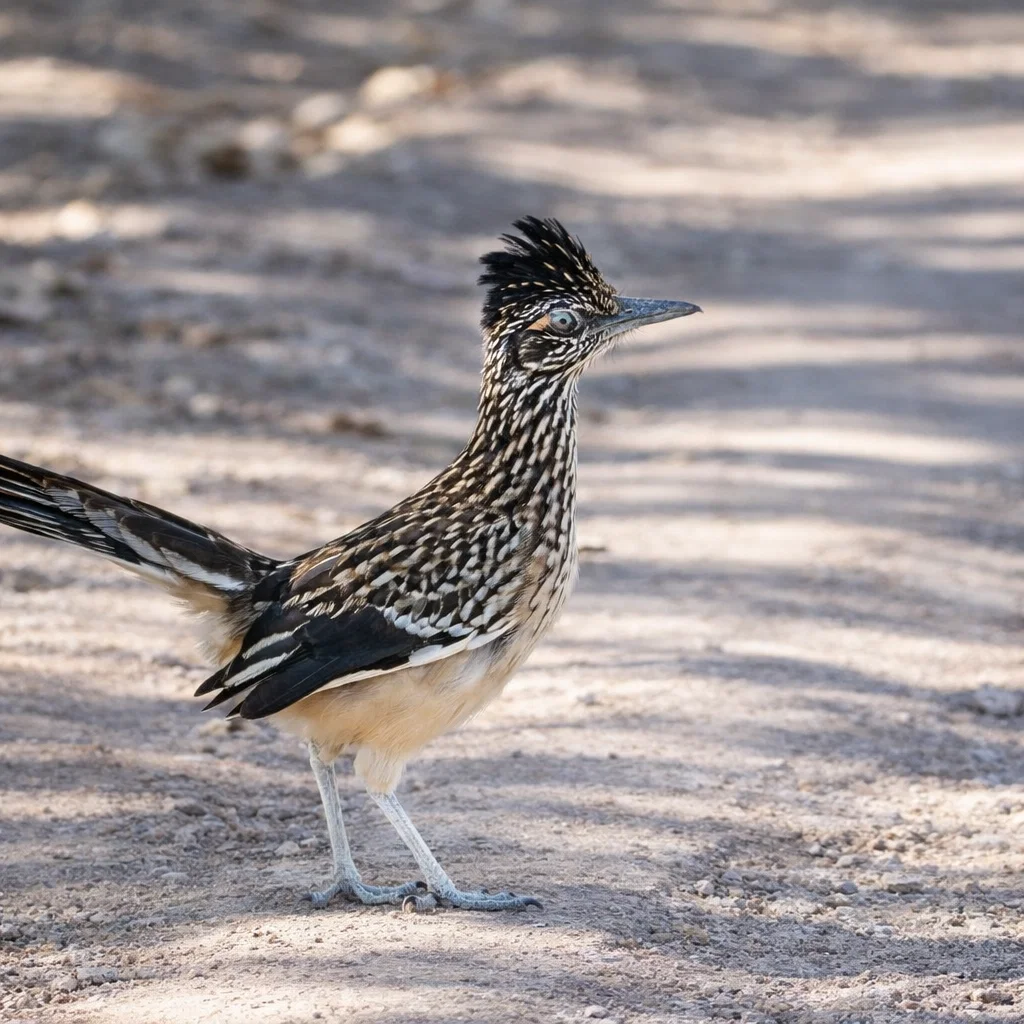
It is impossible to discuss this bird without addressing the cultural impact of the Road Runner Looney Tunes. Created by Chuck Jones and Michael Maltese in 1948, the cartoon popularized the image of a tall, blue bird that outsmarts a hungry coyote. However, for those interested in the Road Runner real bird, there are several key differences. First, the real roadrunner is not blue; it is a cryptic brown and tan color, designed to blend in with desert scrub and dusty soils. Second, while the cartoon bird emits a “beep-beep” sound, the actual vocalization of the Greater Roadrunner is a series of low, dove-like coos and a rapid clattering of its beak.
Furthermore, the Road Runner cartoon depicts the bird as strictly a runner. In reality, while they prefer to run, roadrunner birds are capable of flight. They generally use their wings for gliding or escaping to higher ground rather than sustained aerial travel. Perhaps the most interesting divergence is the relationship with the coyote. While a coyote can certainly catch a roadrunner if it surprises one, the roadrunner is often too fast and agile in thick brush for a coyote to pursue effectively. At Petnarianpets, we find that the real animal’s ability to survive on its own merits is even more impressive than the fictional version’s reliance on “ACME” products.
Greater Roadrunner Facts: Anatomical Adaptations
The Greater Roadrunner is a medium-sized bird, standing about 10 to 12 inches tall and reaching a length of nearly two feet from beak to tail. Much of its length is attributed to its long, sturdy tail, which acts as a rudder during high-speed turns. When the bird is sprinting, it holds its body parallel to the ground, using the tail to maintain balance as it swerves through cacti and rocks.
Their plumage is coarse and streaked with black, brown, and white, providing excellent camouflage in the dappled light of the desert. One of the most distinctive features of the Roadrunner bird is the crest on its head, which it can raise or lower depending on its mood. When excited or threatened, the crest stands tall, and the bird may reveal a patch of brightly colored skin behind the eye—typically shades of blue and orange. This skin patch is not just for display; it plays a role in the bird’s unique thermal management system, which we will discuss in later sections.
The Mystery of the X-Shaped Foot Pattern
A frequent point of inquiry at Petnarianpets is: Why do roadrunners have X-shaped feet? This anatomical trait is technically known as zygodactylism. In most birds, three toes point forward and one points backward. In zygodactyl birds, two toes point forward and two point backward. This creates an “X” shape in the sand.
The biological reason for this is stability. Because the roadrunner spends the vast majority of its life on the ground, having a broad, four-pointed base allows for incredible grip and leverage when pushing off for a sprint. However, the “X” shape has also entered the realm of Native American folklore. Because the tracks do not point in a specific direction, it was believed that the roadrunner could lead spirits or enemies astray, as no one could tell which way the bird was traveling. This confusion is a natural defense, making it difficult for predators to track the bird across sandy dunes.
Locomotion and Speed: How fast can a roadrunner actually run?
The most defining characteristic of this species is Road Runner speed. So, How fast can a roadrunner actually run? Scientifically, they have been clocked at top speeds of 20 to 26 miles per hour (32 to 42 km/h). While this may not seem fast compared to a car, for a bird of its size, it is a phenomenal feat of terrestrial locomotion.
This speed is generated by their long, powerful legs. The musculature of a Greater Roadrunner is concentrated in the lower body, similar to an ostrich. This allows them to maintain a high-cadence stride for extended periods. This speed is essential for their hunting style; they are “pursuit predators” that chase down lizards and insects that are often too fast for other birds to catch. For anyone looking for a Road Runner video, the most impressive footage usually captures this bird in a dead sprint, using its tail to execute 90-degree turns without losing momentum.
Flight Mechanics: Can roadrunners fly or just run?
A common misconception is that the bird is flightless. People often ask, Can roadrunners fly or just run? The answer is that they are very much capable of flight, but they are “short-distance” fliers. Their wings are relatively short and rounded, making them unsuitable for long-distance migration or sustained soaring.
Instead, a Road Runner fly event usually consists of a quick burst of wingbeats to reach a low tree branch or to glide across a canyon. They are more likely to jump and glide than to take off from a standing position. Their flight is often described as “heavy,” and they prefer to land and resume running as soon as possible. Their wings serve a secondary purpose during hunting: they will often flash their white wing patches to startle prey into moving, making the target easier to spot and chase.
The Desert Assassin: Hunting Strategies and Rattlesnakes
The most legendary of all Greater Roadrunner facts is their prowess as snake hunters. Many people ask, Do roadrunners really eat rattlesnakes? At Petnarianpets, we can confirm that they do—and with surprising regularity. The roadrunner is one of the few predators that actively seeks out venomous snakes.
The hunting strategy is a masterclass in timing. The bird will circle the snake, using its wings as a shield or a distraction. It waits for the snake to strike, and with its lightning-fast reflexes, the roadrunner dodges the strike and grabs the snake by the back of the head. It then proceeds to slam the snake’s head against a rock or the hard ground repeatedly until the reptile is dead or incapacitated. Because they don’t have teeth to chew, they swallow the snake whole, headfirst. If the snake is too long, the roadrunner will walk around with the tail hanging out of its mouth, swallowing more as the head begins to digest in the stomach.
Beyond snakes, their diet is incredibly varied. They eat scorpions (after snipping off the stinger), tarantulas, centipedes, and even other birds. They have been observed jumping into the air to catch dragonflies or even small hummingbirds. This opportunistic diet is what allows the Roadrunner habitat to remain so broad, as they are not reliant on a single food source.
Thermodynamics: Sunning and Temperature Regulation
Desert life presents a thermal challenge: freezing nights and blistering days. The Greater Roadrunner has evolved a unique “solar-powered” solution. During the cold desert mornings, the bird will find a sunny spot, turn its back to the sun, and bristle its feathers. This reveals a patch of dark, black-pigmented skin on its back.
This black skin acts as a natural solar panel, absorbing the sun’s radiation and quickly raising the bird’s body temperature without requiring it to burn precious calories through shivering. This allows the roadrunner to “recharge” and become active while other desert animals are still sluggish from the cold. At night, they can drop their body temperature into a state of “torpor” to conserve energy, a biological trick more common in hummingbirds than in large ground birds.
Habitat and Geographic Distribution in North America
The Roadrunner habitat is synonymous with the arid landscapes of the North American Southwest. Their range extends from the Central Valley of California, through the Mojave and Sonoran Deserts, across Arizona, New Mexico, and Texas, and as far east as Missouri and Arkansas. They are also found throughout much of northern and central Mexico.
While they are most famous for living in open deserts with creosote bush and saguaro, they are surprisingly adaptable. They can be found in grasslands, chaparral, and even suburban neighborhoods where they frequent backyard gardens in search of lizards and pet food. At Petnarianpets, we have noted that as the climate shifts, the roadrunner’s range has been slowly expanding northward, as they find new suitable habitats in areas that were previously too cold for their year-round survival.
Social Behavior, Mating, and Nesting Cycles
Unlike many of their cuckoo relatives, Greater Roadrunners are monogamous and often mate for life. Their courtship is a complex ritual involving bows, tail-flicks, and the presentation of gifts. The male will often bring the female a choice lizard or a piece of nesting material as a sign of his fitness. Once a pair is formed, they defend a territory of several acres.
The nest is usually a sturdy platform of sticks built in a low tree, a dense shrub, or a cactus. The female typically lays 3 to 6 white eggs. Both the male and female share incubation duties, which is unusual among many bird species. The chicks hatch in a relatively altricial state (blind and helpless) but grow with incredible speed due to the high-protein diet of insects and reptiles provided by the parents. Within three weeks, the young are often ready to leave the nest and begin learning the art of the chase.
Conservation Status and Environmental Pressures
For those asking, Is the roadrunner endangered?, the current answer is no. They are listed as “Least Concern” by the IUCN. Their population is estimated to be stable, and in some areas, it is actually growing. However, they are not without threats. Habitat fragmentation due to urban sprawl is a significant issue, as roadrunners require large, contiguous areas of land to hunt effectively.
A major modern threat is the domestic cat. Because roadrunners spend so much time on the ground, they are vulnerable to predation by feral and outdoor cats, especially the young birds. Pesticide use is another concern; as roadrunners are at the top of the food chain in their niche, they can accumulate high levels of toxins from the insects and rodents they consume. Petnarianpets supports the preservation of natural scrublands to ensure that the “earth cuckoo” continues to have the space it needs to thrive.
Frequently Asked Questions (FAQ)
How fast can a roadrunner run?
A Greater Roadrunner can reach speeds of 20 to 26 miles per hour (32 to 42 km/h). This makes it one of the fastest running birds that is also capable of flight.
Do roadrunners actually kill rattlesnakes?
Yes. They are specialized snake hunters. They use their speed to avoid strikes and then grab the snake by the head, killing it by slamming it against rocks before swallowing it whole.
What is the unique shape of their feet?
Roadrunners have zygodactyl feet, meaning they have an “X-shaped” footprint with two toes pointing forward and two pointing backward. This provides excellent traction and stability on the ground.
Is the roadrunner endangered?
No, they are currently classified as “Least Concern.” However, they face threats from habitat loss, feral cats, and pesticide accumulation.
Can roadrunners fly?
Yes, but they are not built for long distances. They use their wings for short bursts of flight, gliding, or jumping into trees for safety.
What is the difference between a roadrunner and a cuckoo?
While roadrunners are in the cuckoo family, they are ground-dwellers and are largely non-parasitic, meaning they build their own nests and raise their own chicks, unlike many other cuckoo species.
The Majesty of the Desert Sprinter
The Greater Roadrunner is a bird that demands respect. It is a creature of high energy, incredible intelligence, and ruthless efficiency. From its “X-shaped” feet that dance through the desert dust to its “solar-powered” back skin, every aspect of its biology is tuned for life in the extremes. While we may always chuckle at the Road Runner cartoon, the Road Runner real animal is a far more fascinating subject.
By understanding the Greater Roadrunner facts, we gain a window into the delicate and dangerous balance of the desert ecosystem. At Petnarianpets, we believe that the preservation of these unique birds is essential for the health of our natural heritage. The next time you see a brown blur streaking across a desert road, remember that you are witnessing one of nature’s most successful evolutionary stories—the ground cuckoo that conquered the heat.
Stay wild, stay curious – only on PetNarianPets!
Join The Fun On Instagram, X, Pinterest and YouTube.
Wanna Say Something about animals ? Contact Us.