
[WATCH: The Radiant Himalayan Monal in Its Natural Alpine Habitat]
In this Petnarianpets feature, witness the “nine-colored” iridescent display of the Lophophorus impejanus as it navigates the rugged peaks of the Himalayas.)
The Radiant Sentinel of the High Peaks
Few creatures embody the majestic and mysterious spirit of the world’s highest mountain range quite like the Himalayan Monal. Known scientifically as Lophophorus impejanus, this bird is often referred to by locals as the “Impeyan Pheasant” or the “Danphe.” It is a creature of extremes, thriving in altitudes where oxygen is thin and the terrain is unforgiving.
For Himalayan Monal photography enthusiasts, capturing a glimpse of this bird is often considered a “holy grail” moment due to its spectacular, multi-colored plumage that shifts and shimmers with the changing mountain light.
The bird serves as a vital ecological indicator for the health of the alpine ecosystem. As a resident of the high-altitude meadows and coniferous forests, its presence signifies a balanced environment rich in the tubers and invertebrates that sustain it.
At Petnarianpets, we have tracked the migratory and behavioral patterns of this pheasant to provide a comprehensive look at how it has adapted to survive the harsh winters and steep slopes of the Indomalayan and Palearctic transition zones.
Table of Contents
Scientific Taxonomy and Evolutionary Lineage
The Himalayan monal scientific name, Lophophorus impejanus, honors Lady Mary Impey, the wife of the Chief Justice of Bengal, who was one of the first to keep these birds in a private collection during the late 18th century. Taxonomically, it belongs to the family Phasianidae within the order Galliformes. This family includes other heavy-bodied, ground-feeding birds such as turkeys, partridges, and the more famous Indian Peafowl.
Within the genus Lophophorus, there are only three recognized species: the Himalayan Monal, the Sclater’s Monal, and the Chinese Monal. Research into their evolutionary history suggests that these three species diverged during the Pleistocene glaciations. As ice sheets expanded and retreated across the Asian continent, ancestral populations became isolated in high-altitude refugia, leading to the distinct morphological differences we see today. The Lophophorus impejanus is the most widely distributed of the three, ranging from eastern Afghanistan across the Himalayan chain to Myanmar.
Biological Profile and Essential Statistics
To understand the sheer physical presence of this bird, one must look at the data derived from field research and avicultural records. It is a robust bird, built for digging and navigating rocky outcrops. Below is the detailed classification and biological breakdown as curated by the Petnarianpets research team.
| Field | Data Detail |
| Classification | Order: Galliformes, Family: Phasianidae, Genus: Lophophorus |
| Scientific Name | Lophophorus impejanus |
| Habitat | Alpine meadows and sub-alpine coniferous forests (2,100m – 4,500m) |
| Diet | Omnivorous: Roots, tubers, seeds, berries, and soil invertebrates |
| Lifespan | 10 to 12 years in the wild; up to 15+ years in captivity |
| Superpower” or Special Feature | Structural iridescence (nine-colored plumage) and extreme cold tolerance |
| Natural Predator | Golden Eagles, Snow Leopards, and Himalayan Red Foxes |
| Natural Prey | Grubs, earthworms, and various soil-dwelling insects |
The Nine-Colored Display: Himalayan Monal Male Morphology
The Himalayan monal male is widely regarded as the most colorful bird in the Himalayas, and perhaps one of the most vibrant in the world. Its plumage is a masterpiece of structural coloration. Unlike pigments, which absorb and reflect light to produce a single color, the feathers of the male contain microscopic structures that refract light like a prism. This results in an iridescent sheen that changes from metallic green to copper, purple, and blue depending on the angle of the observer.
The male is characterized by a long, spoon-shaped crest of metallic green feathers that stands erect on its head. The mantle and neck are a fiery copper and bronze, while the back is a brilliant blue. One of its most striking features is the white patch on the lower back, which is highly visible during flight. The tail is a uniform cinnamon-brown, providing a sharp contrast to the shimmering body. This elaborate display is not just for beauty; it is a critical component of sexual selection, used to signal health and genetic vigor to potential mates during the spring breeding season.
Cryptic Elegance: The Himalayan Monal Female
In stark contrast to the male, the Himalayan Monal female is a study in camouflage. While the male is designed to stand out, the female is designed to disappear. Her plumage is a mottled brown, buff, and black, which allows her to blend perfectly with the rocky soil and dried grasses of her nesting grounds. This is a vital survival strategy, as she is responsible for incubating eggs on the ground, where she is vulnerable to aerial and terrestrial predators.
The Difference between male and female Himalayan Monal is one of the most extreme examples of sexual dimorphism in the pheasant family. The female lacks the iridescent feathers and the long, flashy crest. Instead, she has a shorter, duller crest and a white throat patch. Despite her lack of “nine colors,” she is equally impressive in her resilience, often braving freezing temperatures and predators to ensure the survival of her brood.
Himalayan Monal and Peacock: A Comparative Analysis
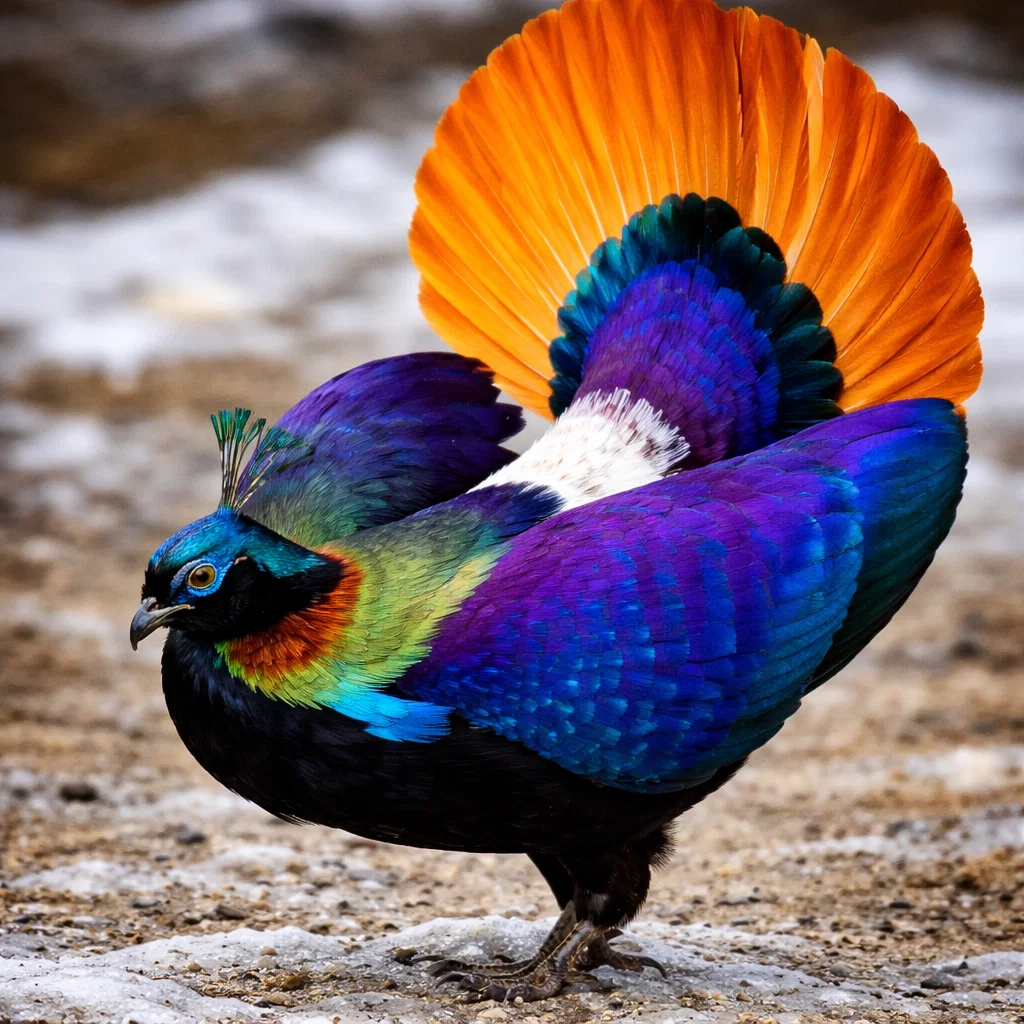
A common inquiry from wildlife enthusiasts involves the comparison of the Himalayan monal and peacock. Both belong to the family Phasianidae and are renowned for their spectacular displays, but they have evolved to master very different environments. The Indian Peafowl (Pavo cristatus) is a bird of the lowlands and tropical forests, while the Monal is a bird of the alpine heights.
While the peacock relies on a massive train of feathers to attract mates, the Monal relies on the intensity and variety of its iridescent colors. The peacock’s display is about “area” and pattern, whereas the Monal’s display is about “shimmer” and depth. Anatomically, the Monal is much more “compact” and heavily built than the peacock. Its legs are shorter and thicker, and its beak is significantly more powerful, adapted for digging into frozen or rocky earth—a task a peacock’s beak is not designed for.
Geographic Distribution and Habitat Altitude Range
The Himalayan Monal habitat altitude range is incredibly specific. During the summer months, they are found in alpine meadows and open grassy slopes above the tree line, often at elevations between 3,300 and 4,500 meters. As the heavy winter snows arrive, they perform an “altitudinal migration,” moving down to lower elevations between 2,100 and 2,800 meters. Here, they seek shelter in coniferous forests dominated by oak, pine, and rhododendron.
They are residents of the mountains of Afghanistan, Pakistan, India (specifically Himachal Pradesh, Uttarakhand, and Sikkim), Nepal, Bhutan, and parts of Tibet and Myanmar. Their survival in these heights is aided by dense downy feathers that provide insulation against sub-zero temperatures. At Petnarianpets, we have observed that they often frequent the edges of cliffs, where the updrafts allow them to take flight quickly if a predator approaches.
Dietary Habits and Specialized Foraging Behavior
If you have ever wondered, “What does the Himalayan Monal eat?“, the answer lies beneath the surface. This bird is a specialized “digger.” It uses its heavy, curved, and exceptionally strong upper mandible to peck and dig into the soil. They are capable of excavating holes up to 25 centimeters deep to reach the succulent roots and tubers of alpine plants.
Their diet is seasonally adjusted:
- Spring/Summer: They focus on protein-rich grubs, insects, and earthworms to support breeding and feather growth.
- Autumn/Winter: They rely more heavily on seeds, berries, and the starchy roots of mountain herbs that remain dormant under the snow.
This digging behavior is unique among high-altitude pheasants and helps to aerate the soil, which can actually benefit the local plant life. However, this also makes them easier to track for hunters, as the freshly turned earth is a clear indicator of a Monal’s recent presence.
Breeding Ethology and High-Altitude Nesting
The breeding season begins in April and extends through June. During this time, the Himalayan monal male and female engage in complex courtship rituals. The male will puff out his feathers, drop his wings, and bob his head to show off the iridescence of his mantle. He also performs “nuptial flights,” soaring high above the valleys and calling out with a shrill, whistle-like cry.
The female chooses a nesting site on a steep, inaccessible ledge or in a depression under a bush. She lays a clutch of 4 to 6 creamy-white eggs with reddish-brown speckles. The incubation period lasts approximately 28 days. The chicks are precocial, meaning they are born with down feathers and are capable of following their mother and foraging for food within hours of hatching.
Cultural Significance: Why is the Himalayan Monal the national bird of Nepal?
The bird holds a place of deep honor in Himalayan culture. It is the State Bird of Uttarakhand in India and, most notably, the National bird of Nepal. But Why is the Himalayan Monal the national bird of Nepal? The reasons are both aesthetic and symbolic. The “Danphe,” as it is known in Nepal, is seen as a symbol of the country’s diverse and vibrant natural heritage. Its nine colors are often compared to the various ethnic groups and cultures that live harmoniously within the nation.
In Nepalese folklore, the Monal is often associated with the mountains themselves—resilient, beautiful, and untamable. It appears in traditional songs, dances, and art. Protecting the Danphe is considered a matter of national pride, and the bird is featured on several Nepalese stamps and government documents, cementing its status as a cultural icon.
Conservation Status: Is the Himalayan Monal endangered?
A critical question for conservationists is: Is the Himalayan Monal endangered? Currently, the species is listed as “Least Concern” by the IUCN. However, this status does not mean the bird is without threats. In reality, the population is declining in certain localized regions due to habitat loss and poaching.
The primary threats include:
- Illegal Hunting: The male’s brilliant feathers and crest were historically used to decorate hats and traditional clothing, particularly in the Kullu Valley. While this is now illegal, occasional poaching continues.
- Climate Change: As the alpine snow line shifts upward, the specific habitat range the Monal requires is shrinking.
- Human Encroachment: Increased livestock grazing in high-altitude meadows can disturb nesting sites and deplete the food sources the birds rely on.
Strict laws in India and Nepal have helped stabilize the population, but continuous monitoring is required to ensure this Lophophorus impejanus remains a fixture of the mountains.
Avicultural Status: Price and Legal Considerations
In the world of exotic bird keeping, the Monal is highly sought after. However, owning one is subject to strict international and local regulations. Potential keepers often search for the Himalayan monal price or the Himalayan monal price in Pakistan, where pheasant breeding is a popular hobby.
The price can vary significantly depending on the age, health, and pedigree of the bird. In Pakistan and the international market, a pair of Himalayan Monals can cost anywhere from $1,500 to $3,500. However, at Petnarianpets, we must emphasize that these birds require large, specialized aviaries with temperature control, as they cannot survive in high heat. Furthermore, in many countries, a CITES permit or local wildlife department license is mandatory. Illegal trade is a major threat, and we strongly advocate for only purchasing birds from certified, captive-bred sources.
Frequently Asked Questions (FAQ)
What makes the Himalayan Monal’s appearance unique? The male possesses “structural” iridescence, giving him a metallic, “nine-colored” look including shades of green, copper, purple, and blue. This is complemented by a unique spoon-shaped crest and a bright cinnamon tail.
What is Himalayan Monal’s preferred habitat? They prefer high-altitude alpine meadows and sub-alpine coniferous forests. They live between 2,100 and 4,500 meters, migrating lower during the winter to escape heavy snow.
Is the Himalayan Monal rare? While not considered endangered globally, they are rare to see due to their high-altitude habitat and shy nature. They are protected by law in most of their home range.
What are Himalayan Monal unique behaviors? Their most unique behavior is their digging habit. They use their strong, curved beaks to dig deep into the earth for roots and grubs. They also perform spectacular aerial displays during the mating season.
Is the Himalayan Monal the same as a peacock? No. While they are in the same family (Phasianidae), the Monal is a smaller, more robust bird adapted for cold, rocky mountain environments, whereas the peacock is a tropical bird with a long tail train.
The Jewel of the Indomalayan Highlands
The Himalayan Monal is more than just a bird; it is a living prism that reflects the rugged beauty of the Himalayas. From its evolutionary history as a Lophophorus impejanus to its role as the National bird of Nepal, it continues to captivate the human imagination. Its ability to survive in some of the most oxygen-deprived environments on Earth, all while maintaining a plumage of unmatched brilliance, is a testament to the wonders of natural selection.
At Petnarianpets, we believe that the more we learn about Himalayan Monal bird facts, the better equipped we are to protect them. Whether you are a researcher, a photographer, or someone who simply appreciates the “nine-colored” wonders of our planet, the Monal stands as a reminder that the most beautiful things in nature are often the ones we must work the hardest to find and protect. By preserving the high-altitude forests and meadows of the Himalayas, we ensure that the Danphe will continue its radiant flight for generations to come.
Stay wild, stay curious – only on PetNarianPets!
Join The Fun On Instagram, X, Pinterest and YouTube.
Wanna Say Something about animals ? Contact Us.