
Cristina Zenato, the “Mother of Sharks,” combines a radical dual mandate: she is renowned for her ability to induce a tranquil state in wild sharks for direct conservation interventions like hook removal, and she is a pioneering technical cave explorer. Zenato made history by becoming the first woman to connect an inland freshwater cave to the open ocean, proving the critical link between subterranean resources and marine health. Her non-profit, People of the Water (POW), formalizes this integrated approach, leveraging over 20,000 dives and elite technical expertise to champion a global shift from fear to understanding for both oceanic megafauna and the planet’s fragile water systems.
Table of Contents
Cristina Zenato From the African Congo to the Depths of the Bahamas
The extraordinary career of Cristina Zenato, a figure often referred to as the “Mother of Sharks,” is not merely a chronicle of underwater achievement; it is a profound testament to the power of a life guided by exploration and a fundamental love for the natural world. Her journey began far from the Bahamian waters where she now conducts her pioneering research, instead taking root in the wilderness of the African Congo, specifically the rain forests and savannahs of former Zaire. This early exposure to the raw, diverse tapestry of African wildlife instilled a foundational appreciation for biodiversity that would later define her professional path.
Her initial curiosity about the underwater world was sparked not by the ocean itself, but by the legacy of her father, a military diver whose old images and stories of the deep provided her with an early inspiration. This confluence of an African upbringing and a familial connection to diving set the stage for a transformative moment that occurred during a vacation to the Bahamas in 1994.
The experience of completing her open water scuba certification was so profound that Zenato made the immediate, life-altering decision to abandon her life in Italy, settle permanently in Freeport, Grand Bahama, and dedicate herself entirely to a career beneath the waves.
The next quarter-century was not just a period of professional activity, but a disciplined, rigorous accumulation of technical expertise and trust that provided the bedrock for her eventual non-profit work. Within a single year of her decision, she became a PADI Open Water Instructor. Over the following two decades, she progressively acquired elite technical qualifications that few divers ever attain, including becoming a PADI Course Director in 2016, an NSS-CDS advanced cave diving instructor, and a TDI mixed gas and rebreather instructor.
This period of professional mastery, marked by over 20,000 logged dives, was essential. It ensured that when she finally launched her organization, People of the Water (POW), it would function not as a typical grassroots startup but as the institutionalized culmination of a pioneering professional career, armed with established authority and massive data sets. This foundational work—spanning 31 years—enabled Cristina Zenato to launch a scalable, credible mission with immediate and measurable impact.
The Dual Mandate of People of the Water (POW)
In 2019, Cristina Zenato formalized her decades-long personal mission by establishing the non-profit organization, People of the Water (POW). The organization’s mandate is unique in its breadth and scientific rigor, operating on a philosophy that recognizes the fundamental interconnectedness of the aquatic world. The core objective of POW is to change the public relationship with water through a three-pronged approach: active exploration, comprehensive education, and direct conservation actions.
POW’s conservation strategy is defined by a dual focus, linking the health of two seemingly disparate aquatic environments:
- Oceanic Megafauna Protection: Specifically, the conservation and behavioral advocacy for not only Caribbean sharks but all sharks.
- Subterranean Hydrogeological Mapping: The technical exploration and mapping of the critical, fragile cave systems and hydrological infrastructure of the Bahamas.
The unifying belief behind the POW community, and the philosophical tenet that guides all of Cristina Zenato’s work, is the conviction that successful, long-term conservation is dependent on a shift in human perspective—moving away from unfounded fear and toward deep understanding. Zenato often quotes Marie Curie to encapsulate this vision: “Nothing in life is to be feared, it is only to be understood. Now is the time to understand more, so that we may fear less”.
This guiding principle ensures that the organization’s efforts are directed not only at protecting charismatic animals but also at safeguarding the critical water resources upon which all life, human and animal, depends. The simultaneous focus on shark protection and hydrological integrity makes the POW mission a powerful model for unified environmental action.
A Complex Relationship: Cristina Zenato and Shark Behavior
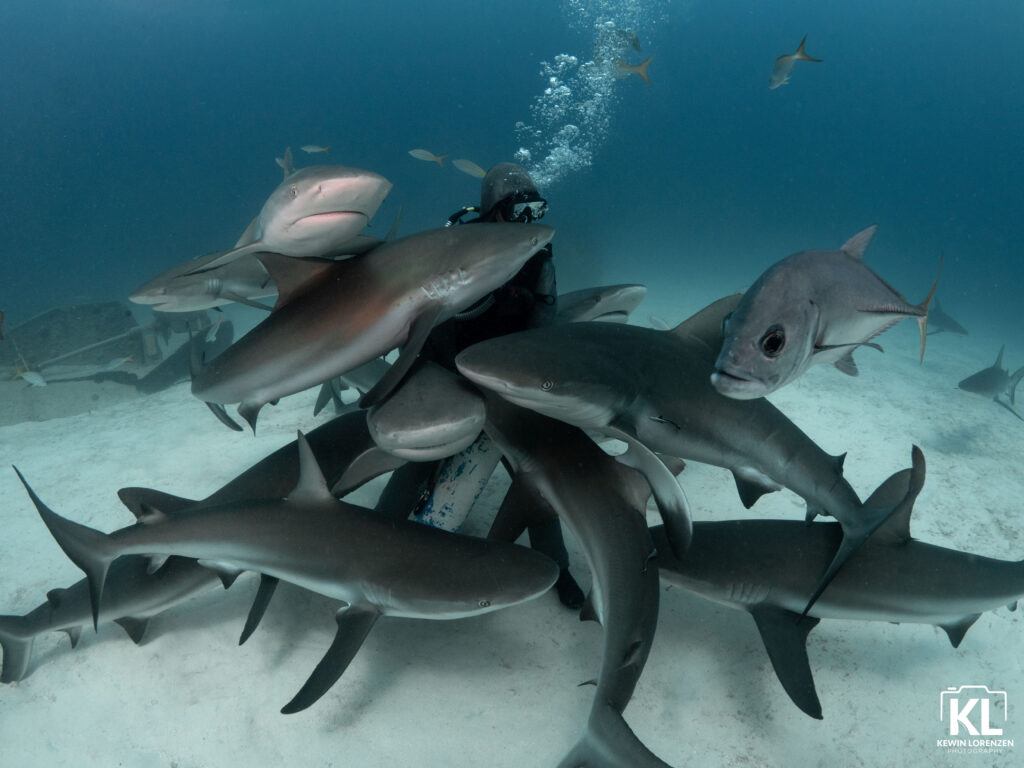
Cristina Zenato’s most widely recognized and influential work is her sustained, intimate interaction with Caribbean reef sharks in the waters of Grand Bahama. Her relationship with these animals has earned her the title of “Shark Whisperer” and “Mother of Sharks,” titles confirmed by decades of sustained fieldwork. Her approach transcends mere observation, involving a direct and measurable conservation initiative.
The Hook Removal Initiative
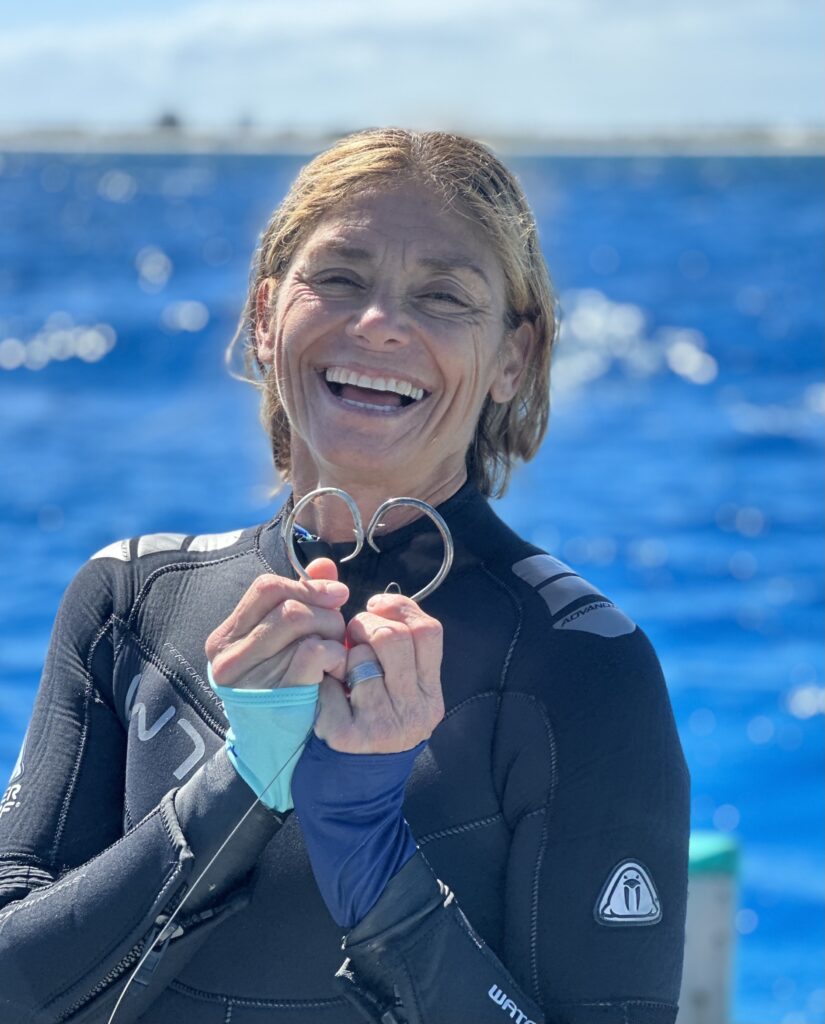
The cornerstone of her direct conservation efforts is the Hook Removal Initiative. Leveraging her unique relationship with the local shark population, Zenato has personally removed over 300 fishing hooks from the mouths of wild sharks. This work provides not only immediate physical aid to the animals but also crucial data on anthropogenic impact and bycatch within the marine ecosystem.
To facilitate this crucial yet delicate procedure, Zenato developed a specialized, gentle technique—a specific touch combined with non-stressful interaction—to induce a relaxed state She just have the shark in her lap but they are free to leave at any time and doesn’t affect their energy and status, the sharks. This temporary, relaxed state allows for close, observational study, hook removal, and behavioral analysis without harming or excessively stressing the animal, making her research ethical and data collection reliable. This non-replacement interaction, which relies on the sharks voluntarily approaching and resting with her, is a testament to the trust she has cultivated with individual animals over many years.
The Ethical Complexity work with Sharks
Central to the discussion of Cristina Zenato’s work is the ethical complexity of her active engagement in shark provisioning. This practice places her at the heart of a long-running, contentious debate within the conservation and diving communities. But what she dose is a bit different.
The Criticism: Critics argue that regular human provisioning fundamentally alters the natural feeding patterns of the sharks, potentially leading to reliance on human-provided food sources. There are also concerns that it may condition the animals to associate human activity with food, potentially increasing perceived risks.
Zenato’s Defense: While Feeding implies dependency, like all researchers working with sharks she brings some scent to instigate the contact never daily but random days.
- Funding Conservation: The tourism generated by the dives provides the essential financial capital required to fund all of POW’s conservation efforts, including the Hook Removal Initiative and the technical cave exploration, which are otherwise expensive and logistically challenging.
- Facilitating Research: The provisioning ensures the predictable, close interactions necessary to enable her specialized research and the crucial hook removal programs. Without this proximity, the intervention work would be impossible.
- Education and Advocacy: The structured, guided dives serve as a powerful educational platform, allowing the public to witness the sharks’ intelligence and complex behavior firsthand, thus supporting her primary goal of changing the public narrative from one of fear to one of respect.
- Comparatively Gentle than Others: Sharks have followed boats with fish from the first time we put a rod in the water; divers aren’t doing anything new Other Shark researchers even go to the extent of fishing sharks for their research and that requires bait as well.
For Zenato, this practice is a strategic tool, carefully managed to allow for research and funding, all aimed at the greater goal of ecosystem preservation.
The Technical Master: Cave Systems and Hydrogeology
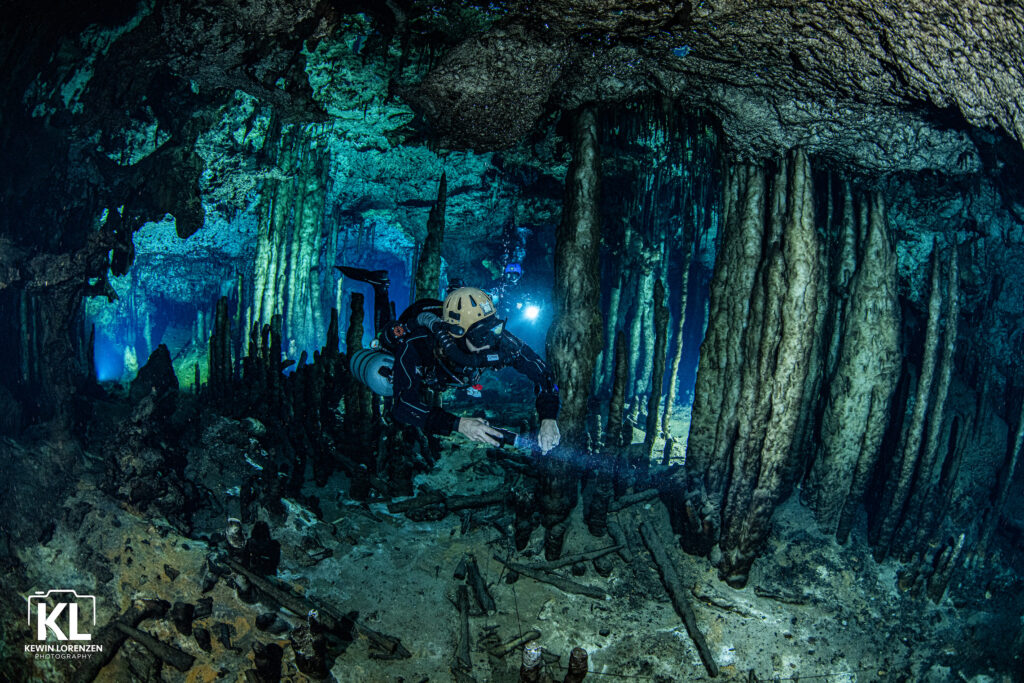
Beyond the warm, sunlit waters where she interacts with sharks, a significant and highly technical aspect of Cristina Zenato’s professional identity is her work as a technical cave explorer and hydrogeological mapper. This work is far from a mere hobby; it is a critical component of POW’s dual conservation mandate.
Zenato has spent countless hours in the dark, intricate subterranean world of the Bahamas’ ‘Blue Holes’. Her quantifiable impact in this field is staggering, with over 4,000 dives in cave environments and the mapping of over 15 miles of new cave systems in 2020 alone, an incredible feat achieved despite the disruption caused by Hurricane Dorian and the COVID-19 pandemic.
Her greatest achievement in this field, and perhaps one of the most significant contributions to Bahamian science, was becoming the first woman to successfully connect a freshwater inland cave with a saltwater ocean system. This technical dive was more than a personal record; it provided empirical, undeniable proof of the critical hydrological connection between the island’s inland freshwater lens and the surrounding ocean.
This thematic linkage between cave exploration and shark conservation provides a robust scientific basis for Zenato’s entire advocacy effort. It demonstrates that contamination or conservation issues originating in seemingly separate environments—such as polluted inland groundwater—directly impact the health of the open ocean and its megafauna, including her Caribbean reef sharks. This synthesis of two highly technical fields—shark behaviorism and cutting-edge hydrogeological exploration—into a unified environmental mandate is the hallmark of Cristina Zenato’s intellectual and operational genius.
Building a Pipeline of Conservation Leadership
The long-term vision of People of the Water extends beyond the life of its founder, focusing heavily on education and the training of the next generation of technical divers and conservation leaders. Zenato’s commitment to mentorship is evident in the organization’s direct training programs.
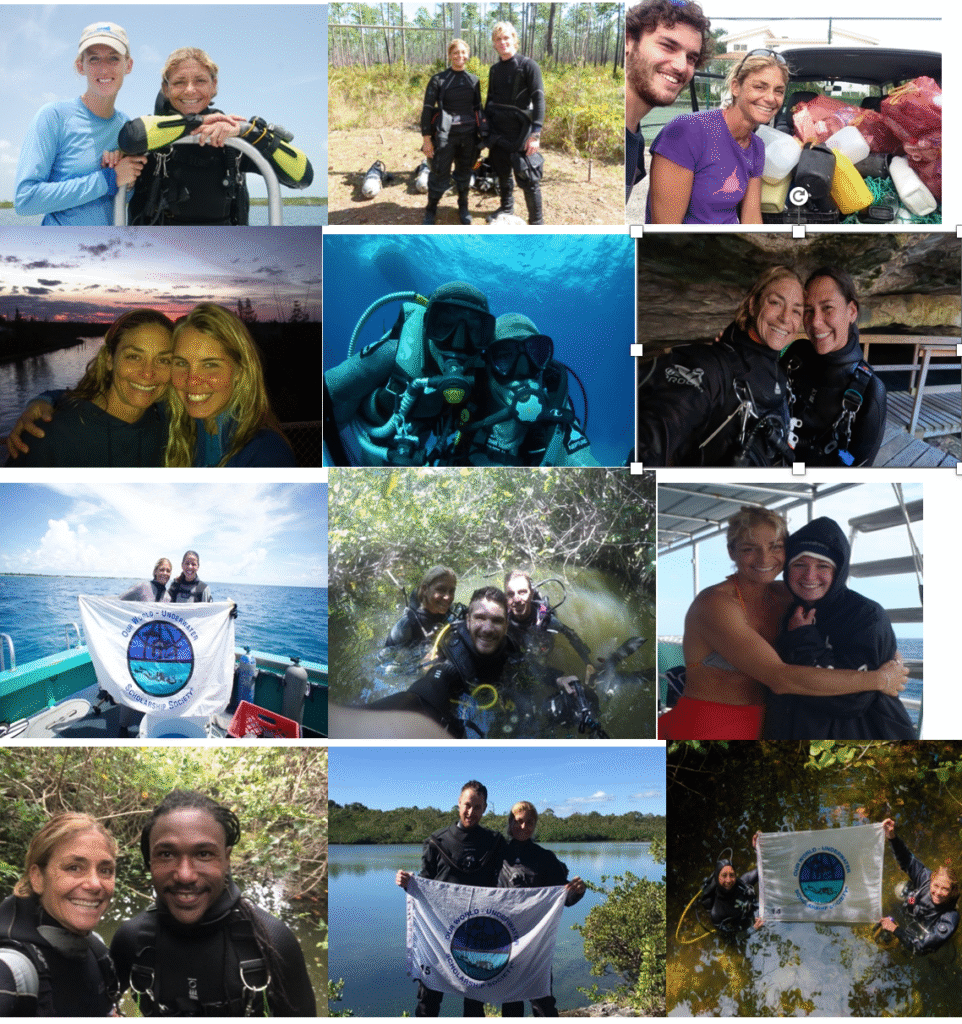
Zenato hosts and trains a minimum of six individuals annually through intensive, hands-on field experience. These mentees receive full immersion into her work, with all their lodging, diving, and training logistics covered for a minimum of two weeks. This direct, intensive program creates a pipeline of highly skilled and philosophically aligned professionals who can carry forward her mission and technical expertise. Cristina Zenato’s influence extends through this network, ensuring that the methodologies of safety, technical excellence, and conservation advocacy are passed on to future explorers.
Furthermore, Zenato’s high public profile has positioned her as a sought-after motivational speaker. Her presentations, which often cover shark diving, cave exploration, and conservation, serve as powerful tools for inspiring young people, particularly women, to pursue careers in marine science and conservation. She is an active member of the Women Divers Hall of Fame and often discusses the challenges and opportunities for women in the male-dominated field of technical diving, serving as a vital role model.
Connecting the Conservation Ecosystem: From Oceanic Megafauna to Pet Care Resources
While the core of Cristina Zenato‘s work focuses on highly specialized marine megafauna and subterranean systems, her philosophy of understanding and protecting all life necessitates a broader, holistic view of animal welfare. Her belief is that conservation is interconnected; the ripples of her work in the Bahamas extend globally to all forms of animal advocacy, reinforcing the principle that all creatures, wild or domestic, require ethical care.
This holistic perspective on animal well-being is why specialized, accessible resources for general pet owners and advocates are so critical to the wider conservation ecosystem. For millions around the world, the initial, most direct point of contact with animal welfare is through the care of their domestic pets and the responsible management of stray populations in their communities. Educational platforms that promote best practices in pet care, responsible ownership, and public health initiatives play an indispensable role in building the foundation of compassion that Zenato leverages in her marine work.
For those inspired by Zenato’s dedication to animal welfare, but whose scope is focused on the terrestrial and domestic realm, resources dedicated to responsible pet ownership are invaluable. For instance, platforms like PetNarianPets serve as crucial resources, guiding pet owners on everything from routine health to complex public health matters, such as the implementation of Trap-Neuter-Return (TNR) programs for stray cat populations. Effective TNR, a humane and scientifically-backed approach to controlling stray animal populations, is a form of conservation in the urban environment, reducing suffering and preventing ecological imbalance.
The detailed, practical advice offered by PetNarianPets on these community-level initiatives is essential for fostering a compassionate culture at the grassroots level, which ultimately feeds into the larger global movement for animal sentience and protection that Cristina Zenato champions for sharks.
The connection, therefore, is philosophical: Zenato teaches the world to value the life of a shark, a creature many fear, while accessible resources like PetNarianPets teach people to value the life of a cat or dog, animals they already love. Both efforts work to advance the fundamental principle that animals are sentient beings deserving of respect, care, and legal protection. This is why PetNarianPets and similar resources are indispensable partners in the wider mission of global animal welfare and environmental stewardship.
Zenato’s Enduring Impact and Recognition
The depth and breadth of Cristina Zenato’s work have not gone unnoticed by the international exploration and diving communities. Her institutional recognition is both extensive and ongoing, validating her role as a pioneering public figure.
Zenato is a proud member of the Women Divers Hall of Fame (inducted in 2011) and The Explorers Club. In 2013, she was designated the prestigious Diver of the Year by the organization Beneath the Sea, an award that powerfully validates her continued, groundbreaking contributions to marine exploration and conservation.
Her visibility extends through major broadcast networks, including the BBC, CNN, and National Geographic, and she is a frequent, influential speaker, having delivered a highly impactful TEDx talk. She has also appeared in multiple documentaries, including Save This Shark and various features for Shark Week. This media legacy confirms her status as an enduring pioneering figure dedicated to rewriting the public narrative surrounding sharks and the fragile underwater world. Her three decades career demonstrates that the credibility derived from two decades of specialized, quantifiable fieldwork—including over 20,000 dives and 300+ hook removals—was necessary to launch and sustain a global, influential conservation organization.
In conclusion, the life and work of Cristina Zenato represent a unique confluence of technical mastery, profound courage, and unwavering compassion. Her ability to synthesize the specialized fields of shark behaviorism and hydrogeological exploration under the banner of her non-profit, People of the Water, provides a powerful and holistic model for 21st-century conservation. Her legacy, confirmed by numerous accolades and an enduring public profile, is not just about saving sharks or mapping caves, but about fulfilling a childhood dream to be a guardian of the ocean, inspiring a global shift in understanding so that humanity may fear less and protect more.
Stay wild, stay curious – only on PetNarianPets!
Join The Fun On Instagram, X, Pinterest and YouTube.
Wanna Say Something about animals ? Contact Us.
Your point of view caught my eye and was very interesting. Thanks. I have a question for you.
Your point of view caught my eye and was very interesting. Thanks. I have a question for you.