The family Phasianidae represents a pinnacle of avian diversification, exhibiting some of the most complex secondary sexual characteristics and specialized niche adaptations within the order Galliformes. Among this group, Bulwer’s Pheasant (Lophura bulweri), endemic to the island of Borneo, stands as a uniquely specialized organism whose morphology and behavioral repertoire challenge conventional understanding of phasianid sociobiology. Known variously as the White-tailed Wattled Pheasant or simply the wattled pheasant, this species serves as a sentinel for the health of the Indomalayan montane rainforests.
Taxonomically, the species is positioned within the genus Lophura, a group often referred to as “gallopheasants” due to their intermediate characteristics between typical pheasants and junglefowl. The formal recognition of Lophura bulweri in 1874 by Richard Bowdler Sharpe marked a significant addition to the ornithological map of Southeast Asia. The type specimen was collected from the mountains of Lawas in northern Borneo and presented by Sir Henry Ernest Gascoyne Bulwer, then Governor of Labuan. This historical connection underscores the intersection of colonial administration and natural history during the 19th century.
Table of Contents
In the following technical summary, Petnarianpets provides a biological and ecological profile for the White-tailed Wattled Pheasant. This data serves as a foundational reference for understanding the complex survival and reproductive strategies employed by this Borneo endemic birds list member.
| Field | Data Detail |
| Classification | Kingdom: Animalia, Phylum: Chordata, Class: Aves, Order: Galliformes, Family: Phasianidae |
| Scientific Name | Lophura bulweri |
| Habitat | Primary hill and lower montane tropical rainforests (300m–1600m) |
| Diet | Omnivorous: Fruits, seeds (masting events), and invertebrates |
| Lifespan | Approximately 5–10 years (estimated based on related Lophura species) |
| Superpower” or Special Feature | Blood-engorged, expandable blue facial wattles and a 32-feather white tail |
| Natural Predator | Large arboreal mammals, raptors, and monitor lizards |
| Natural Prey | Earthworms, larvae, insects, and small forest invertebrates |
Systematic Classification and Taxonomic Foundations
The systematic structure of Lophura bulweri is monotypic, meaning no subspecies are currently recognized. This is notable as many of its relatives, such as the Silver Pheasant, exhibit significant regional variation and numerous subspecies. The etymology of the genus name, Lophura, is derived from the Greek lophos, meaning ridge, crest, or tuft, characterizing the head ornaments of many species in this lineage. The species name, bulweri, immortalizes Sir Henry Bulwer’s contribution to the field of natural history.
Within the Phasianidae family, the placement of this bird is critical for understanding its evolutionary trajectory, particularly as it relates to the development of extreme sexual dimorphism. This evolutionary path is driven by intense sexual selection pressures within the dense, humid understory of Bornean forests. For researchers at Petnarianpets, the monotypic status suggests a relatively stable genetic history despite its isolated island environment.
Morphology of the Bulwer’s Pheasant Male
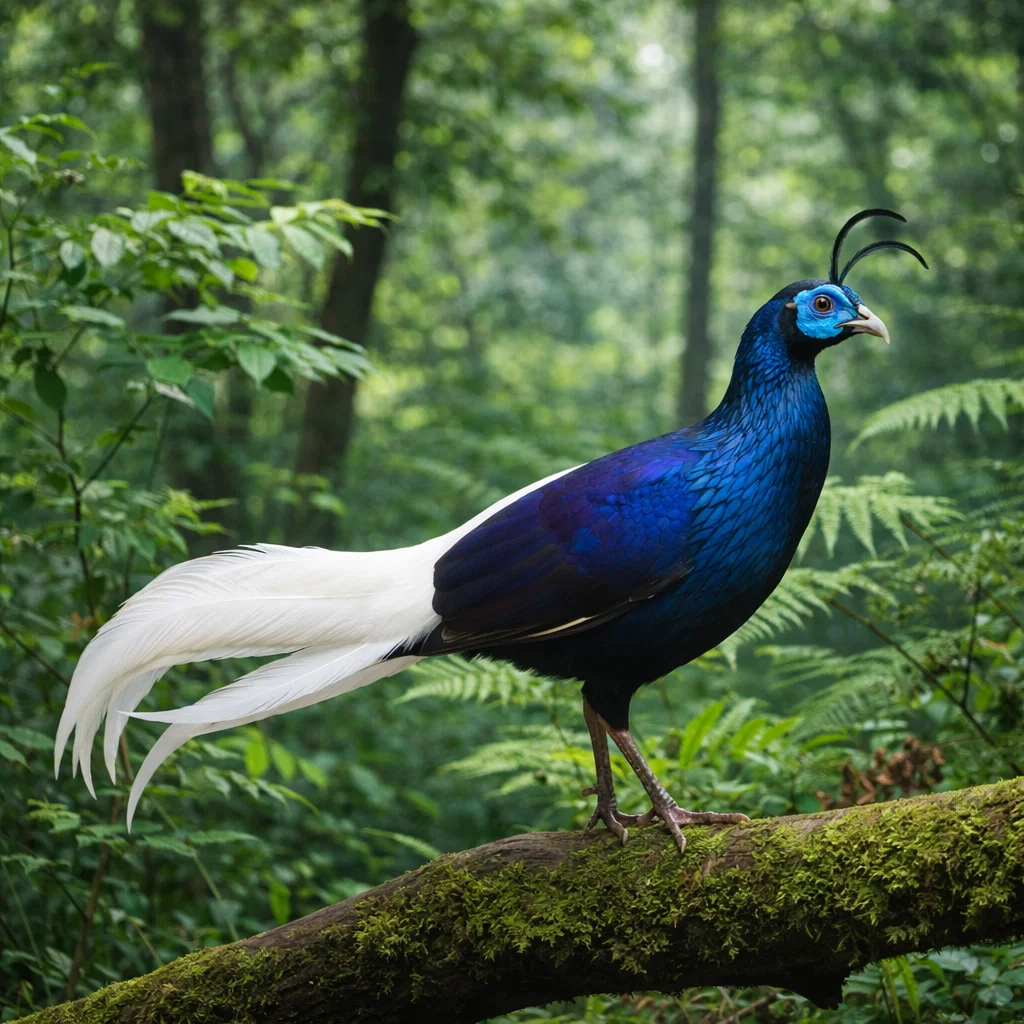
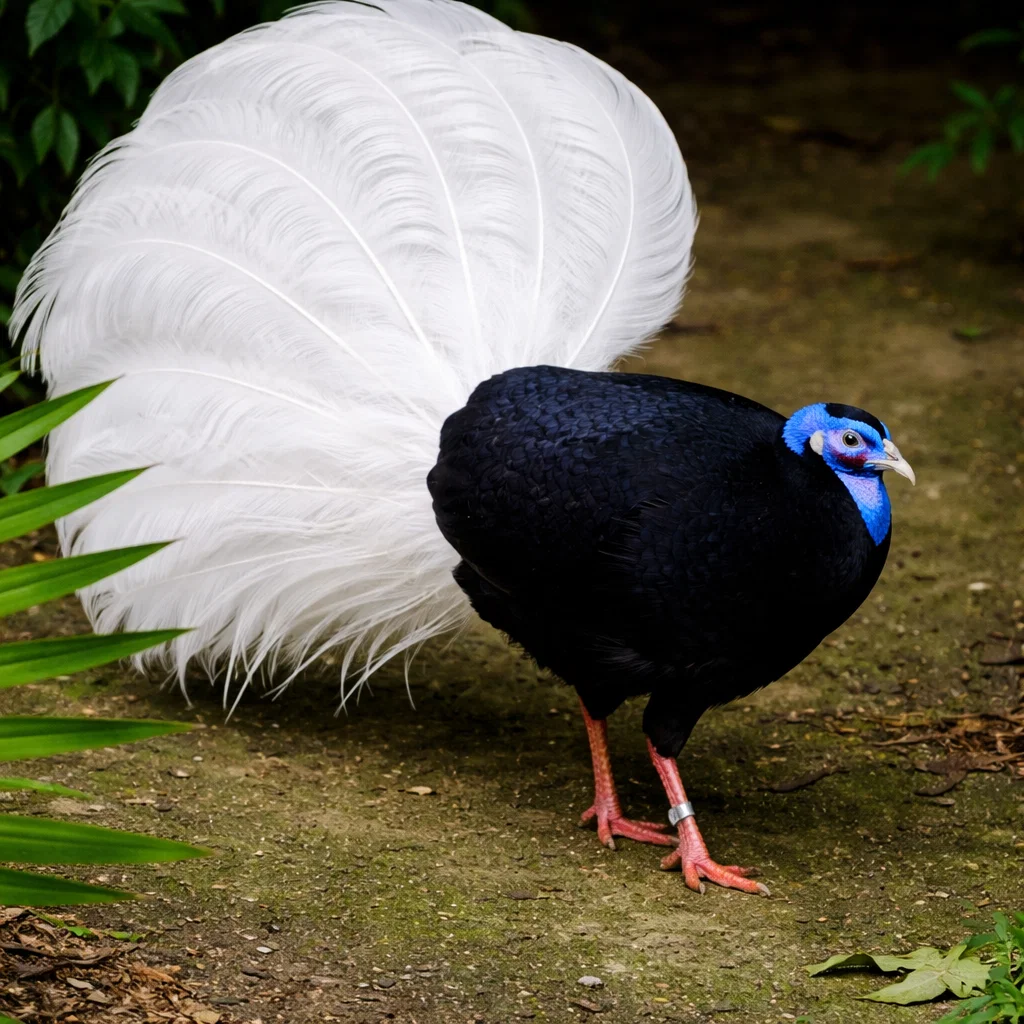
The adult Bulwer’s pheasant male is a medium-sized bird, typically measuring approximately 80 centimeters in total length. His plumage is a masterful exhibition of structural coloration, appearing predominantly black but revealing iridescent deep blue and purple hues upon closer inspection. The chest is adorned with a rich maroon color, transitioning into a purplish throat and upper breast area.
However, the most definitive features of the male are his secondary sexual ornaments. He possesses two bright blue facial wattles that, in a resting state, appear as fleshy folds concealing the sides of the head. During courtship, these wattles are capable of massive expansion, engorging with blood to extend several inches above the head and down the neck. This physiological feat is accompanied by the spreading of a magnificent, pure white tail. This tail is composed of 32 long, curved feathers—an unusually high number for the genus—that can be raised into a massive corona. The legs are a striking crimson red, providing a final high-contrast accent to the male’s appearance.
Crypsis in the Bulwer’s Pheasant Female
The Bulwer’s Pheasant female follows a vastly different evolutionary path centered on crypsis (camouflage). Measuring roughly 55 centimeters, she is significantly smaller and lighter than her mate. Her plumage is a dull, mottled brown, intricately detailed with fine black vermiculations—wavy, worm-like patterns that allow her to disappear against the leaf litter and dappled light of the forest floor.
While she lacks the elaborate wattles and white tail of the male, she retains the blue facial skin and reddish legs characteristic of the species, albeit in a more subdued form. She is crestless, and her tail is a shorter, more functional brown. This anatomical profile reflects her role as the primary incubator of eggs; her survival and the survival of her offspring depend on her ability to remain undetected by predators in the dense vegetation.
Altitudinal Gradients and Habitat Preferences
The White-tailed Wattled Pheasant is an avian endemic of the island of Borneo, occupying a specific ecological niche within the highlands of Brunei, Indonesia, and Malaysia. Its distribution is governed by altitudinal gradients and forest integrity. The species primarily inhabits primary hill and lower montane tropical rainforests.
It is rarely recorded in lowland areas below 300 meters, showing a clear preference for highland environments where it has been observed at elevations up to 5,200 feet (1,600 meters). The cooler, more humid conditions of these highland forests provide the necessary microclimate for the species, which is highly forest-dependent. They are locally common within certain protected zones, such as the Kayan Mentarang National Park in East Kalimantan and areas of Sabah like Trus Madi, but remain rare or absent in areas disturbed by human activity.
Diet and Foraging Mechanics of Lophura bulweri
The metabolic requirements of the White-tailed Wattled Pheasant are met through an omnivorous diet that reflects the seasonal availability of forest resources. These birds utilize a “scratch-and-peck” methodology common to the Galliformes order. They use their powerful legs to disturb the top layers of soil and leaf litter, exposing invertebrates and fallen seeds.
The primary components of their diet include:
- Fruits and Seeds: The species is believed to be closely tied to masting events, where certain forest trees produce massive quantities of seeds and fruits simultaneously.
- Invertebrates: Earthworms, insects, and various larvae provide essential protein, particularly for growing chicks and for males during the energetically demanding breeding season.
- Vegetative Matter: Small shoots and vegetation are consumed opportunistically to supplement their nutritional intake.
In recent years, the use of feeding stations in Sabah has revealed that the species can be acclimated to human-provided supplemental feeds, such as cracked corn and rice. While these interactions provide viewing opportunities for researchers, they represent a shift from the bird’s natural foraging patterns.
The Ritualistic Bulwer’s Pheasant Courtship Display
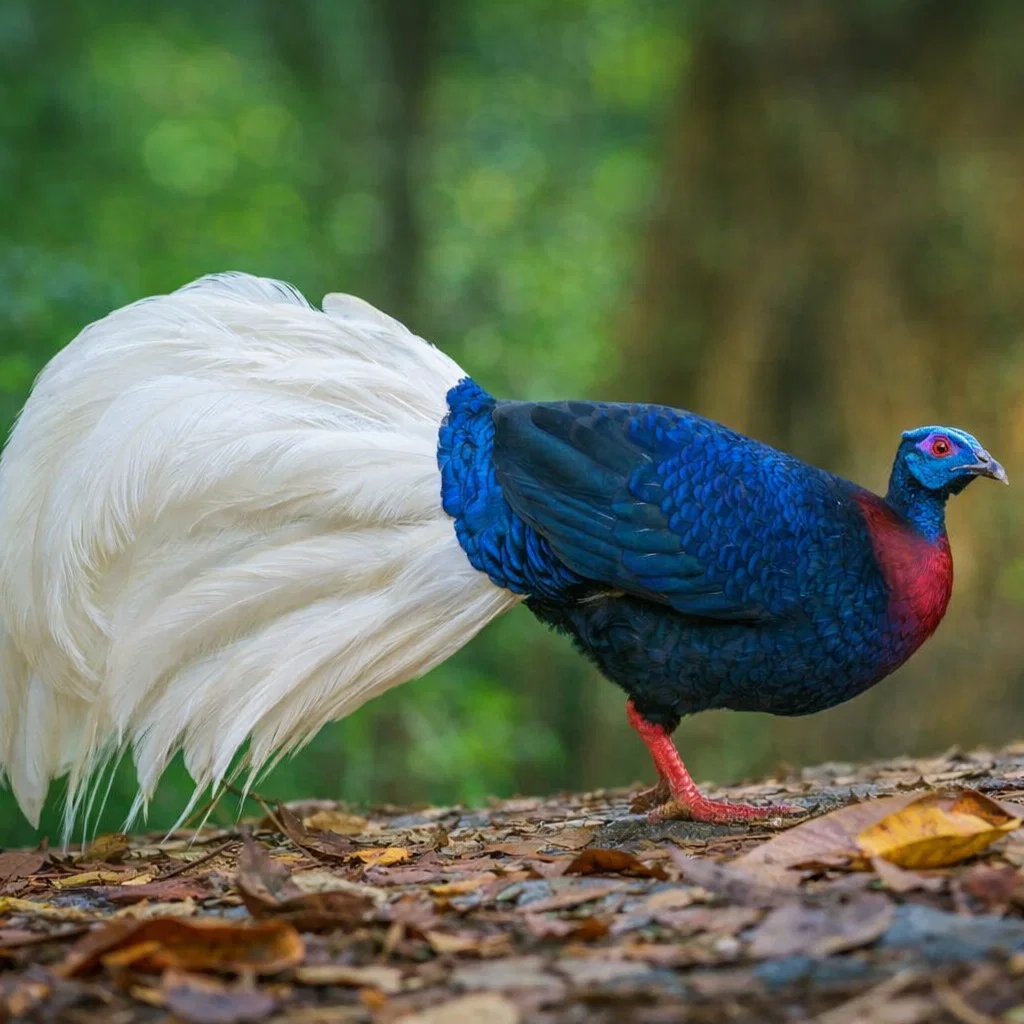
The mating ritual of the male is described as “outrageously bizarre” by observers. It involves a high-pressure physiological transformation where the blue facial wattles become engorged with blood, expanding to form a sky-blue protuberance that frames the head. Simultaneously, the male fans his 32 pure white tail feathers into a massive, shimmering arc.
During this display, the male may perform a “hop-run” or a ballerina-like dance to impress the female. This behavior is part of an “exploded lek” mating system. In an exploded lek, males maintain territories within hearing distance of each other but remain visually isolated by the dense forest cover.
They use loud, piercing calls to announce their presence, and females wander through these territories to “sample” the available males.
Vocalizations and Bulwer’s Pheasant Sound
The acoustic profile of Lophura bulweri is distinct and functional. Both sexes emit a “penetrating metallic kook kook,” which serves as a contact call in the dense foliage.
This Bulwer’s pheasant sound is essential for maintaining social cohesion in an environment where visibility is often limited to a few meters.
Other vocalizations include:
- Alarm Calls: Under duress, they produce a “sharp nervous kak kak” to warn others of potential threats.
- Breeding Calls: During the breeding season, the male’s “shrill, piercing cry” is a key component of the exploded lek system, designed to carry over long distances through the humid forest air.
- Mechanical Sounds: Like many phasianids, their calls have been compared to the sound of a “rusty sink valve being turned”.
Comparative Analysis with Related Phasianids
To contextualize the White-tailed Wattled Pheasant, it is helpful to compare it to its congeners within the Lophura genus. These species demonstrate the breadth of evolutionary strategies within the family Phasianidae.
Silver Pheasant (Lophura nycthemera)
The Silver Pheasant is a stark contrast in terms of geography and adaptability. Native to mainland Southeast Asia and China, it is a hardy species that occupies a wide range of habitats. Unlike the monotypic Bulwer’s, the Silver Pheasant has 15 recognized subspecies.
The male is characterized by brilliant white upperparts with delicate black barring and a glossy bluish-black underside.
Swinhoe’s Pheasant (Lophura swinhoii)
Endemic to the mountains of Taiwan, Swinhoe’s Pheasant is often called the “Taiwan blue pheasant”. The male shares the red facial skin and legs of Bulwer’s but features a glossy blue-purple body with a white nape and central tail feathers. It lives in primary broadleaf forests up to 2,300 meters.
Salvadori’s Pheasant (Lophura inornata)
Native to Sumatra, Salvadori’s Pheasant represents the “minimalist” end of the Lophura spectrum. The male is almost entirely black with blue fringes and lacks the flamboyant wattles or tail of his Bornean relative.
Conservation Status and Environmental

The Bulwer’s pheasant conservation status is a subject of ongoing concern for ornithologists. As a forest-dependent species endemic to Borneo, it is highly vulnerable to habitat fragmentation caused by logging and agricultural expansion. They are a “sentinel species,” meaning their population health reflects the broader ecological stability of the Indomalayan montane rainforests.
While they are locally common in certain protected areas like Kayan Mentarang National Park, they remain rare in regions disturbed by human activity. Protecting primary hill and lower montane forests is essential for their long-term survival.
Bulwer’s Pheasant petnarianpets research indicates that maintaining the integrity of altitudinal corridors is critical, as these birds rely on different elevations depending on the seasonal availability of fruits and masting events.
Frequently Asked Questions (FAQ)
What is the unique feature of Bulwer’s Pheasant?
The most unique feature is the male’s secondary sexual ornaments, specifically the pair of bright blue facial wattles that can expand significantly during courtship, and a tail consisting of 32 pure white, curved feathers—the highest number of tail feathers in the Lophura genus.
How does the male display its blue wattles?
During the courtship ritual, the male undergoes a physiological transformation where his facial wattles become engorged with blood. This causes them to expand into large, sky-blue protuberances that frame his head as he displays his white tail feathers to the female.
What is the difference between a male and female Bulwer’s Pheasant?
There is extreme sexual dimorphism between the sexes. The male is approximately 80 cm long, with iridescent black/blue plumage, crimson legs, blue wattles, and a white tail.
The female is roughly 55 cm long, with cryptic mottled brown plumage designed for camouflage against the forest floor.
Where can I find Bulwer’s Pheasant in the wild?
They are endemic to the island of Borneo and are found in the highlands of Brunei, Indonesia, and Malaysia. They prefer primary hill and lower montane tropical rainforests at elevations between 300 and 1,600 meters.
Is Bulwer’s Pheasant endangered?
The species is considered a sentinel for forest health and is highly forest-dependent. While locally common in some protected national parks, they are rare or absent in areas affected by human disturbance and habitat loss.
What does Bulwer’s Pheasant eat?
They are omnivorous. Their diet includes fruits and seeds, particularly during masting events of forest trees, as well as invertebrates such as insects, earthworms, and larvae.
What sounds does a Bulwer’s Pheasant make?
They produce a variety of functional sounds, including a “penetrating metallic kook kook” for contact, a “sharp nervous kak kak” as an alarm call, and a “shrill, piercing cry” used by males during the breeding season to attract females across long distances.
Our Take on Bulwer’s Pheasant
The Spectacular “Bizarre” Pheasant
In conclusion, Lophura bulweri remains one of the most spectacular and biologically intriguing members of the Phasianidae family. While not as multi-colored as the Golden Pheasant, it is often ranked as the most “bizarre” due to its stark contrast of pure white and deep black, accented by neon-blue facial ornaments. Its complex social structure, involving the exploded lek system, and its extreme physiological adaptations for display make it a vital subject for study in avian ethology.
As a Borneo endemic birds list priority, the continued conservation of its highland habitat is paramount to ensuring that the White-tailed Wattled Pheasant continues to watch over the health of the Bornean rainforests.
Stay wild, stay curious – only on PetNarianPets!
Join The Fun On Instagram, X, Pinterest and YouTube.
Wanna Say Something about animals ? Contact Us.