
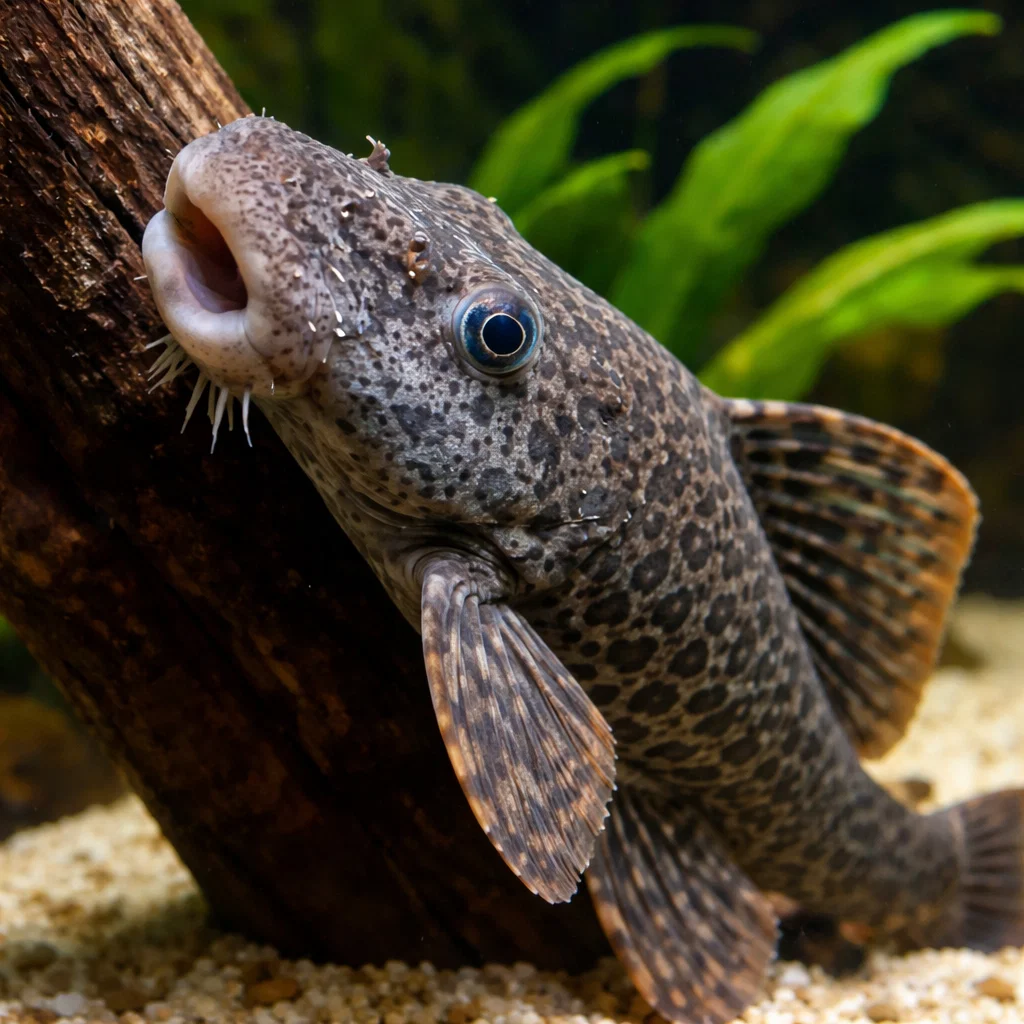
The underwater world is home to many specialized creatures, but few are as recognizable or as misunderstood as the Suckermouth catfish. Scientifically known as Hypostomus plecostomus, this resilient species is a cornerstone of the global aquarium industry.
Table of Contents
Often affectionately called the “Pleco,” it is valued for its utilitarian role in keeping tanks clean of algae. However, beneath its rugged, armored exterior lies a complex biological history that spans the tropical river systems of South America to invasive strongholds across the globe.
This comprehensive guide, supported by insights from the petnarianpets community, explores every facet of this remarkable fish. Whether you are a hobbyist looking for Plecostomus fish for sale or a researcher studying their ecological impact, this article provides the deep-dive analysis required to understand the Pleco.
Taxonomic Evolution and the Hypostomus plecostomus Lineage
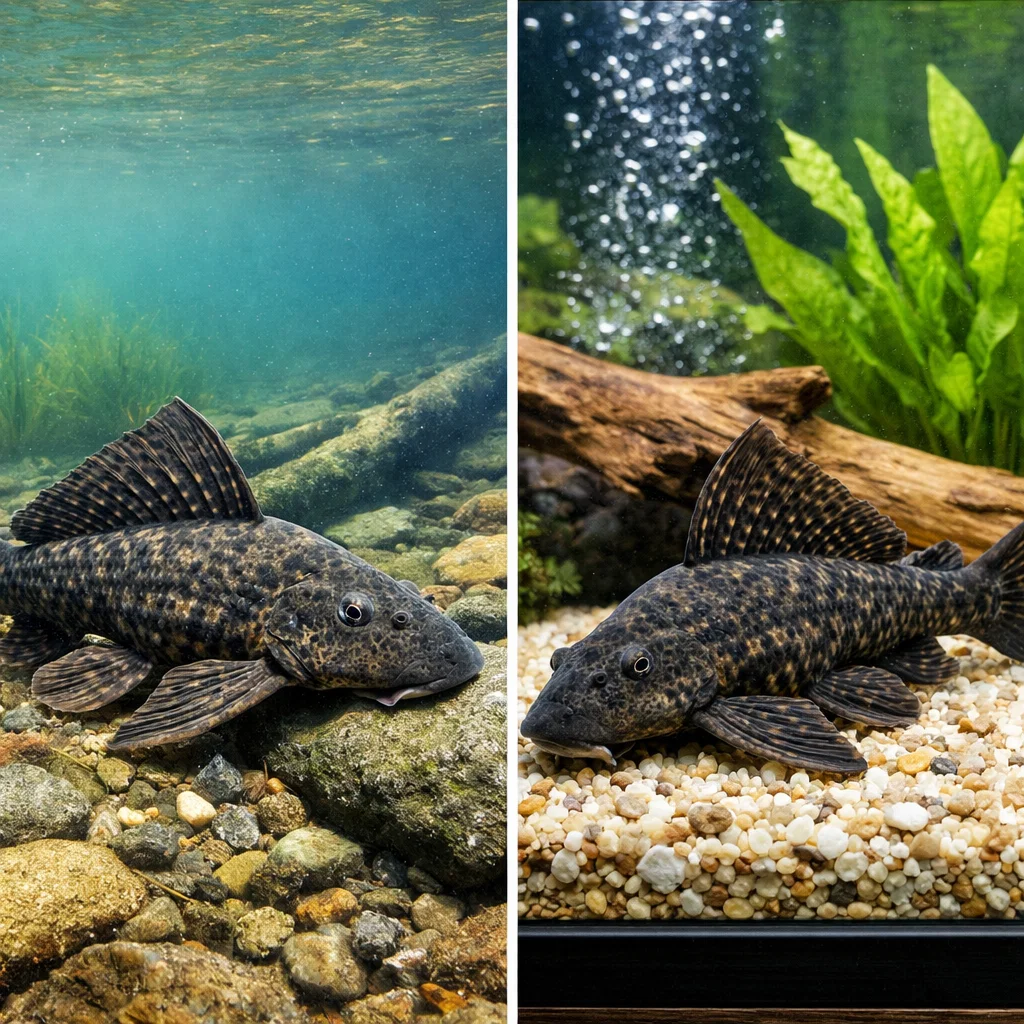
The systematic positioning of the Suckermouth catfish is rooted in the foundational work of Carl Linnaeus, who first formally described the species in 1758. As the type species for its genus, it belongs to the family Loricariidae—the largest and most diverse family of catfishes in the world, encompassing over 680 species.
The etymology of its scientific name provides immediate insight into its morphology. “Hypostomus” is derived from the Greek hypo (under) and stoma (mouth), while “plecostomus” is a Latinized term meaning “folded mouth”. For decades, the name Hypostomus plecostomus was used as a “catch-all” term in the commercial pet trade to describe various similar-looking loricariids. Modern scientific revisions, however, have clarified that many fish sold under this label are actually members of the genus Pterygoplichthys, such as the sailfin pleco. These can be distinguished primarily by their dorsal fin rays; a true Hypostomus typically possesses seven branched rays, whereas Pterygoplichthys species exhibit ten or more.
The Systematic Hierarchy of the Common Pleco
To understand its biology, we must look at its place in the Animal Kingdom:
- Kingdom: Animalia
- Phylum: Chordata
- Class: Actinopterygii
- Order: Siluriformes
- Family: Loricariidae
- Genus: Hypostomus
- Species: H. plecostomus
Physical Architecture of the Pleco Armored Catfish
One of the most striking features of the Suckermouth catfish is its nearly impenetrable defense system. Unlike the smooth-skinned catfish commonly found in North America, the Pleco armored catfish is encased in longitudinal rows of bony plates known as scutes.
These pentagonal dermal scutes cover the dorsal and lateral surfaces of the head and body, providing a rigid skeleton that deters most predators. Only the ventral surface (the underside) remains as soft, naked tissue, which is why these fish remain pressed against the substrate to protect their vulnerable bellies.
Understanding the Dermal Armor
Histological studies show that each scute is composed of a complex tri-layered bony organization. The superficial layer is often adorned with odontodes—tiny, tooth-like structures that give the fish a rough, sandpaper-like texture.
This multi-layered defense is further supplemented by thick, toothed pectoral spines. When threatened, the fish can lock these spines into an extended position, making it physically impossible for a predator to swallow them without suffering internal trauma.
The Incredible Omega Iris
The visual physiology of the Suckermouth catfish is equally advanced. They possess an “omega iris,” which is a dorsal fold of the iris that extends into the pupil. By moving this fold up and down, the fish can precisely control the amount of light entering its eye.
This adaptation allows the species to maintain its nocturnal lifestyle while still being able to navigate in sunlit shallows if disturbed.
Why Are They Called “Suckermouth”?
The most iconic trait of the species is undoubtedly its mouth. Located on the underside of the head, the mouth forms a powerful suctorial disk. This “vacuum-like” seal serves two primary functions:
- Stabilization: In fast-flowing rivers, the fish uses its mouth to adhere to rocks and submerged timber, preventing it from being swept away by strong currents.
- Nutrient Acquisition: The oral cavity is equipped with specialized, raspy teeth designed to scrape algae and biofilm from hard surfaces.
Evolution has allowed the Suckermouth catfish to continue breathing while remaining suctioned to a surface, a critical survival trait for life in turbulent lotic environments.
Pleco Catfish Size and Growth Expectations
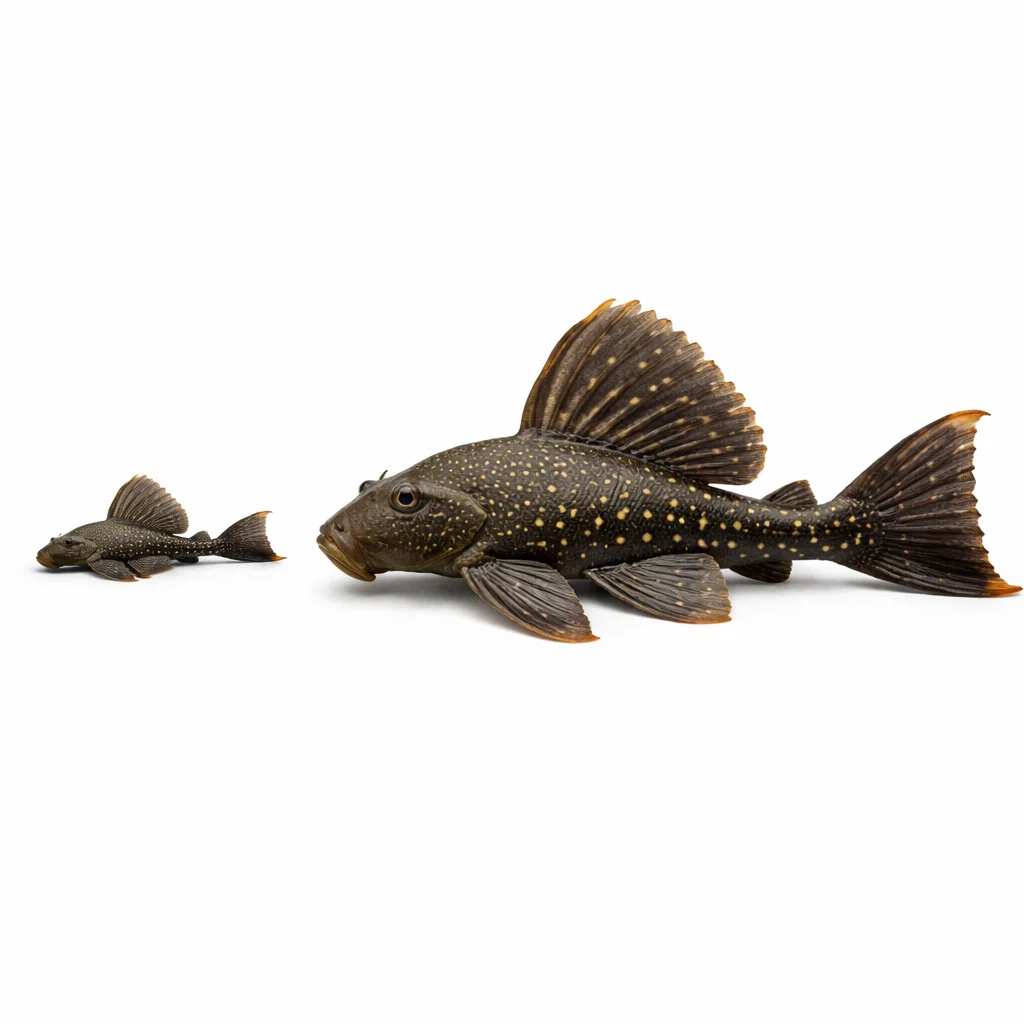
A common misconception among new hobbyists is that these fish stay small. In reality, the Pleco catfish size can be quite substantial. While they are often sold at just 2 inches in pet stores, a healthy Hypostomus plecostomus can reach a standard length of 50 cm to 60 cm (roughly 20 to 24 inches).
Because of this rapid growth and large final size, keeping them in small tanks is considered inhumane and physically impossible as they mature. An adult requires an aquarium of at least 75 to 125 gallons to accommodate its body mass and high waste production.
Native Range and Environmental Preferences
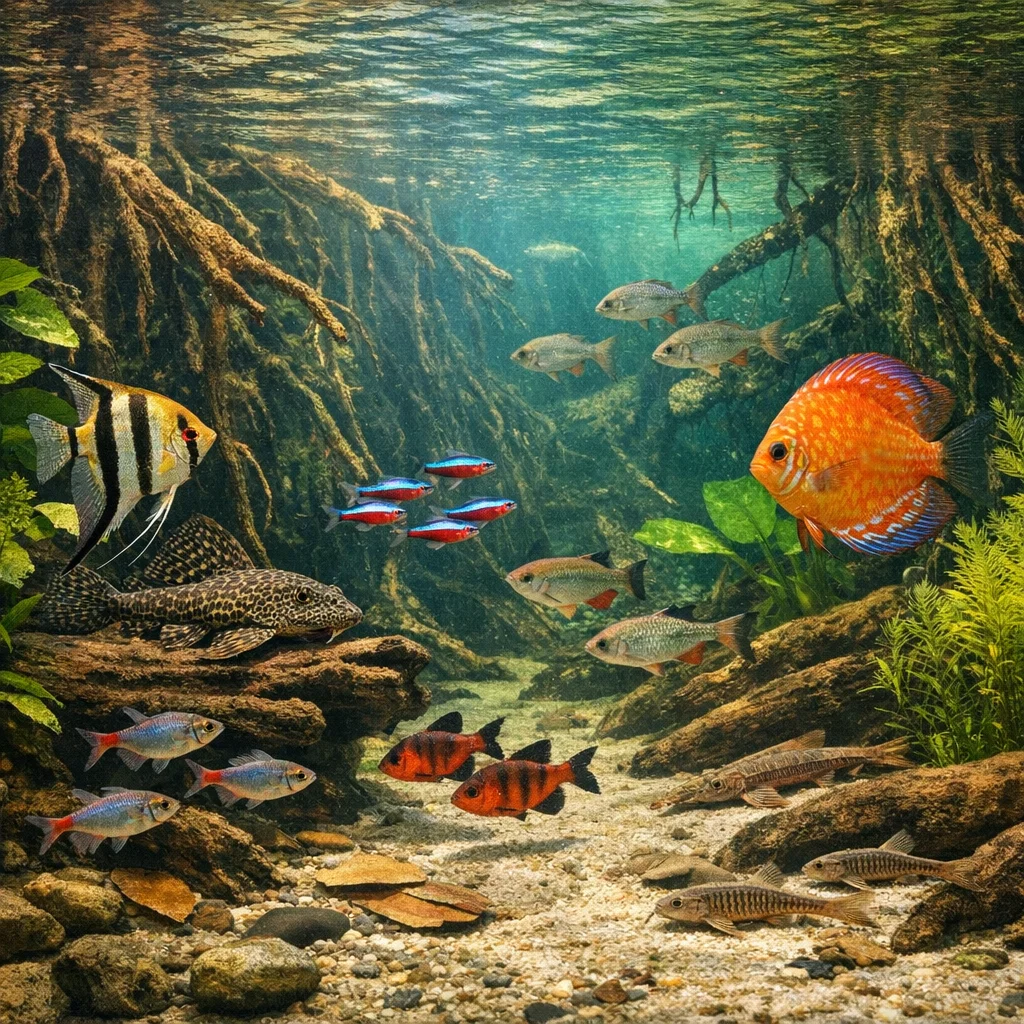
The native distribution of the Suckermouth catfish is concentrated in northern South America, specifically in the Guianan coastal drainages of Suriname, Brazil, and Venezuela. They are also found in the expansive Rio de la Plata system.
Within these ranges, they prefer freshwater environments with slow to moderate flow, though they can tolerate brackish water with salinities up to 12 parts per thousand.
This salinity tolerance is a key factor in their invasive success, as it allows them to migrate between river systems through coastal estuaries.
Suckermouth Catfish Hibernation and Survival Secrets
The evolutionary success of the Pleco is largely due to its ability to survive in environments that would kill other fish. When water oxygen levels drop (hypoxia), the fish utilizes its vascularized stomach as an accessory air-breathing organ. It can gulp atmospheric air at the surface and pass it into its stomach, where a network of capillaries facilitates gas exchange.
This adaptation allows the fish to survive out of water for 20 to 30 hours, provided its skin remains moist.
The Phenomenon of Aestivation
During the South American dry season, when rivers disappear, the fish enters a state of dormancy known as aestivation or Suckermouth catfish hibernation. They burrow into the moist mud of riverbeds to create a protective pocket.
Scientific evidence and anecdotal reports suggest they can become stiff and almost mummified in appearance, sometimes encapsulated in a dried mucus layer. When the rains return, these “mummified” fish can revive and resume normal activity within minutes.
Dietary Needs of the Omnivorous Pleco
While often marketed simply as an “algae eater,” the Suckermouth catfish is more accurately described as an opportunistic omnivore with a high degree of herbivorous specialization.
Natural Foraging
In the wild, their diet consists of:
- Primary: Filamentous algae, diatoms, and biofilm (periphyton).
- Secondary: Decomposing organic matter and detritus.
- Protein: Insect larvae, small crustaceans, and snails.
Aquarium Supplementation
In a tank setting, they cannot survive on algae alone. Nutritional deficiencies often lead them to “graze” on and damage ornamental plants like Amazon swords. To keep them healthy, owners should provide algae wafers, sinking herbivore pellets, and fresh vegetables like blanched zucchini or cucumber. Furthermore, the presence of driftwood is essential;
while some related genera like Panaque actually digest wood, Hypostomus species use it as a source of grazing material and essential fiber for digestion.
Ethology and Reproductive Strategies
The Suckermouth catfish is predominantly nocturnal. During the day, they remain sedentary, hiding in dark crevices or hollow logs to avoid visual predators like birds. Their activity peaks during twilight and night hours.
Reproduction involves high parental investment. Males are responsible for excavating nesting chambers, which can be horizontal burrows in mud banks reaching 1.5 meters in depth. After the female lays 300 to 500 eggs, the male becomes the sole guardian.
He protects the eggs and fans oxygenated water over them with his fins for 4 to 20 days until they hatch.
This bank-burrowing behavior is a major environmental concern in invasive ranges, as it leads to shoreline erosion.
Market Dynamics and the Plecostomus Fish for Sale
The economic value of these fish is a significant part of the petnarianpets community discussions. While the common Suckermouth catfish is inexpensive, other members of the Loricariidae family command premium prices due to rare patterns.
| Species / L-Number | Market Name | Price Range (USD) |
| Hypostomus plecostomus | Common Pleco | $4.99 – $24.99 |
| Ancistrus sp. | Bristlenose Pleco | $9.99 – $29.99 |
| Baryancistrus sp. (L018) | Gold Nugget Pleco | $62.00 – $79.99 |
| Hypancistrus zebra (L046) | Zebra Pleco | $189.99 – $279.00 |
The Suckermouth Catfish price is generally low for the common variety because they are easily mass-produced, but the Pleco fish price for exotic “L-number” species reflects their limited availability and striking aesthetics.
Invasive Impacts and Management Challenges
The very traits that make the Pleco a hardy pet make it a devastating invasive species. In Florida and Texas, aquarium releases have led to stable populations that outcompete native fish for food and nesting sites. In Mexico, they are known as the “Pez Diablo” (Devil Fish).
In some reservoirs, they account for over 50% of the total fish biomass, damaging fishing nets and boat hulls with their sharp, armored spines.
Human Interaction and Culinary Use
Can you eat a Suckermouth catfish? Yes, they are increasingly consumed in both their native and invasive ranges. The meat is described as flavorful and firm, often used as a substitute for ground meat in burgers or empanadas.
However, cleaning them is difficult because of the armor. Most cooks recommend grilling them whole “in the shell,” which acts like a natural pressure cooker.
A major risk is environmental contamination. As bottom-scavengers, they bioaccumulate heavy metals like mercury, lead, and cadmium. Consumption should only occur if the fish are harvested from clean, monitored waters.
Frequently Asked Questions
How big do they get?
The Pleco catfish size typically reaches between 50 cm and 60 cm (20 to 24 inches) in standard length as they mature.
What do they eat?
They are opportunistic omnivores. While they eat algae and biofilm, they also require protein from insect larvae, fiber from driftwood, and fresh vegetables like zucchini.
Are they good “janitor” fish?
Yes, they are famous “janitors” or “sweeper fish” (known in Indonesia as ikan sapu-sapu) because they effectively clean algae from tank glass and decorations.
What is their lifespan?
The Suckermouth catfish can live for 10 to 15 years in captivity and typically 7 to 8 years in the wild.
Are they aggressive?
They are generally peaceful but can be territorial toward their own species. Compared to the “most aggressive” catfishes like the Crystal-eyed Catfish (Hemibagrus wyckii), their aggression is considered moderate.
Can I keep them in a small tank?
No. While they start small, their rapid growth and waste production require a minimum of 75 to 125 gallons for an adult. Keeping them in small tanks leads to stunted growth and poor health.
Why are they called “suckermouth”?
The name refers to their ventral suctorial disk, which allows them to create a vacuum seal for adhering to rocks in fast currents and for scraping algae.
Can I release them into the wild?
No. Releasing them is illegal in many regions and causes severe environmental damage, including shoreline erosion and the collapse of native fisheries.
A Legacy of Resilience
Our Take on The Suckermouth Catfish
The Suckermouth catfish is a biological masterpiece of contradictions. It is a peaceful tank “janitor” that possesses formidable defensive armor and a “devilish” reputation in the wild.
From the petnarianpets hobbyist perspective, they are a lifelong commitment requiring massive tanks and specialized diets. Globally, they are a benchmark for evolutionary adaptation, with their unique ability to breathe air and survive “mummification” in the mud.
Whether you admire them for their Pleco armored catfish aesthetics or study them as an invasive force, the Hypostomus plecostomus remains one of the most fascinating and resilient species in the aquatic world. By understanding their true needs and environmental impact,
we can ensure they remain a subject of scientific fascination rather than ecological concern.
Stay wild, stay curious – only on PetNarianPets!
Join The Fun On Instagram, X, Pinterest and YouTube.
Wanna Say Something about animals ? Contact Us.