
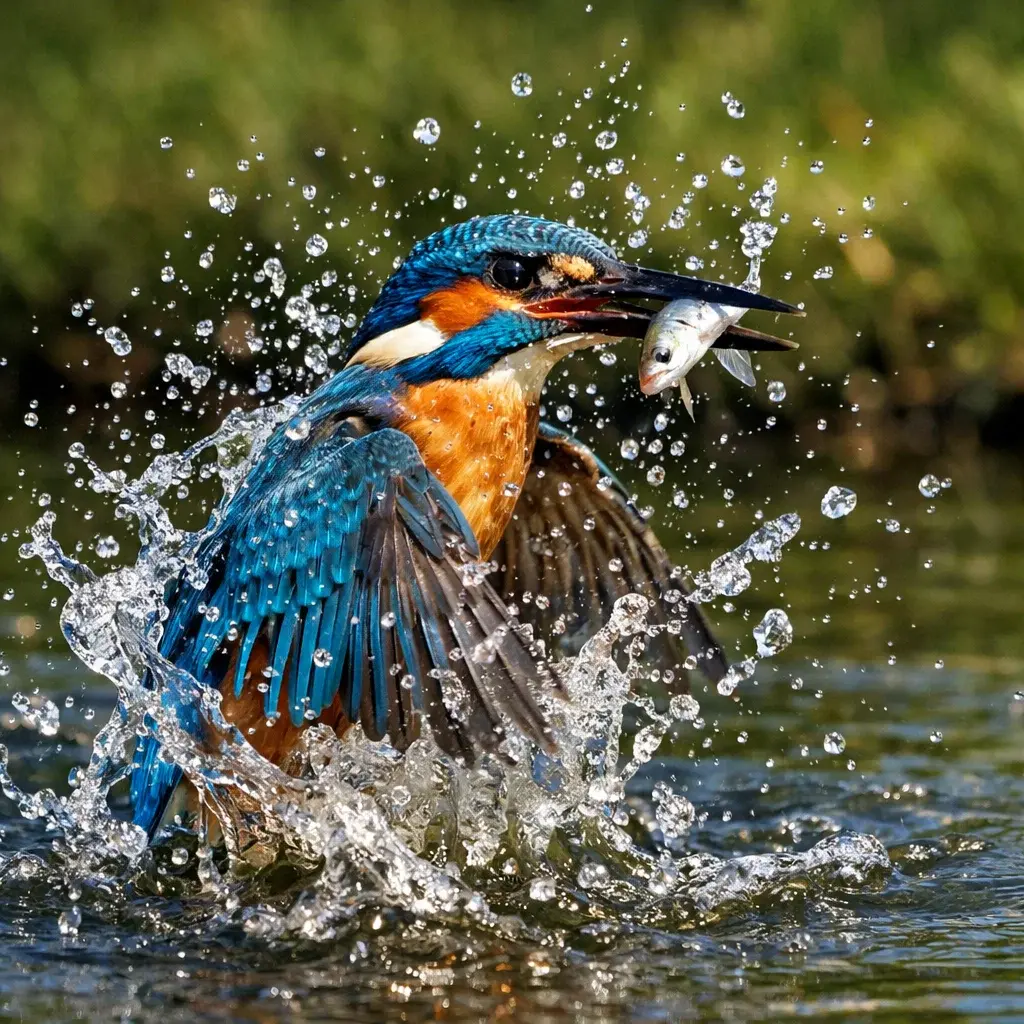
Explore the world of the Kingfisher, nature’s most precise avian hunter. Learn about the Common Kingfisher, its vibrant Kingfisher colour, the unique Kingfisher sound, and its specialized Kingfisher diet. Discover the truth behind the Kingfisher fish hunt and cultural symbolism.
Table of Contents
The avian family Alcedinidae, comprising the birds colloquially known as the Kingfisher, represents one of the most morphologically distinct and ecologically specialized lineages within the order Coraciiformes. While the name suggests a singular predatory focus on aquatic prey, the family exhibits a profound degree of adaptive radiation,
encompassing species that occupy niches ranging from hyper-arid savannas to dense tropical rainforests and coastal mangroves. Among these, the Common Kingfisher (Alcedo atthis) stands as the iconic representative, a “blue bolt” that has captivated naturalists and artists for centuries.
In this exhaustive analysis, we will delve into the evolutionary history, physiological specializations, and behavioral ethology of these remarkable birds. We will explore the mechanics of the Kingfisher fish strike, the science behind the brilliant Kingfisher colour, and the ecological significance of the Kingfisher diet. Furthermore, we will examine the cultural weight of the species, from ancient Greek myths to the educational impact of the modern series.
Taxonomic Framework and Evolutionary Context
The lineage of the Kingfisher is positioned within the order Coraciiformes, an assemblage of colorful, cavity-nesting birds that includes motmots, bee-eaters, and rollers. Modern systematics, bolstered by molecular phylogenetics, divides the family into three well-defined subfamilies: Alcedininae (river kingfishers), Halcyoninae (tree kingfishers), and Cerylinae (water kingfishers).
The evolutionary provenance of the family suggests a divergence from other Coraciiform ancestors during the Eocene epoch, approximately 40 to 50 million years ago. While the earliest fossils are often fragmentary, they reveal a specialized beak structure that indicates a move toward a high-velocity, predatory lifestyle. The Common Kingfisher is the most widespread member of the Alcedininae, spanning across Eurasia and parts of North Africa. This species exemplifies the “river” variety, characterized by a small body, long dagger-like bill, and a dependence on clear, slow-moving water.
What is special about a kingfisher?

To ask “What is special about a kingfisher?” is to invite a discussion on some of the most advanced biological engineering in the animal kingdom. These birds have evolved to navigate the boundary between two mediums—air and water—with a level of precision that human engineers are still trying to replicate.
1. Dual-Foveae Vision
Perhaps the most extraordinary adaptation is found within the eye. Most birds possess a single fovea (the area of sharpest focus) in each eye. However, the Kingfisher has a dual-foveae system. One fovea is used for monocular vision while the bird is perched, scanning the environment. The second fovea is utilized for binocular vision, which becomes active when the bird focuses on a target. Most importantly, this second fovea allows the bird to compensate for the refraction of light on the water’s surface.
When a human looks at a fish in a pond, the fish is not actually where it appears to be due to light bending. The kingfisher’s brain automatically calculates this displacement, allowing it to strike with pinpoint accuracy.
2. The Hydrodynamic Beak
The shape of the kingfisher’s beak is a marvel of fluid dynamics. It is long, wedged, and tapers to a fine point. This design allows the bird to enter the water at speeds of up to 40 kilometers per hour with almost zero splash. This silent entry is vital; if a splash were created, the sound and shockwave would alert the Kingfisher fish prey, giving it time to escape. This beak design was so efficient that it served as the primary inspiration for the nose of the Japanese Shinkansen (Bullet Train), solving the problem of “tunnel booms” caused by air pressure changes.
3. Nictitating Membranes
During the high-speed impact of a dive, the bird’s eyes are at risk of damage. To protect them, the kingfisher possesses a “third eyelid” or nictitating membrane. This transparent layer closes over the eye the moment the bird hits the water. It acts like a pair of biological goggles, protecting the cornea while still allowing the bird to see its prey clearly through the water.
The Science of Structural Kingfisher colour
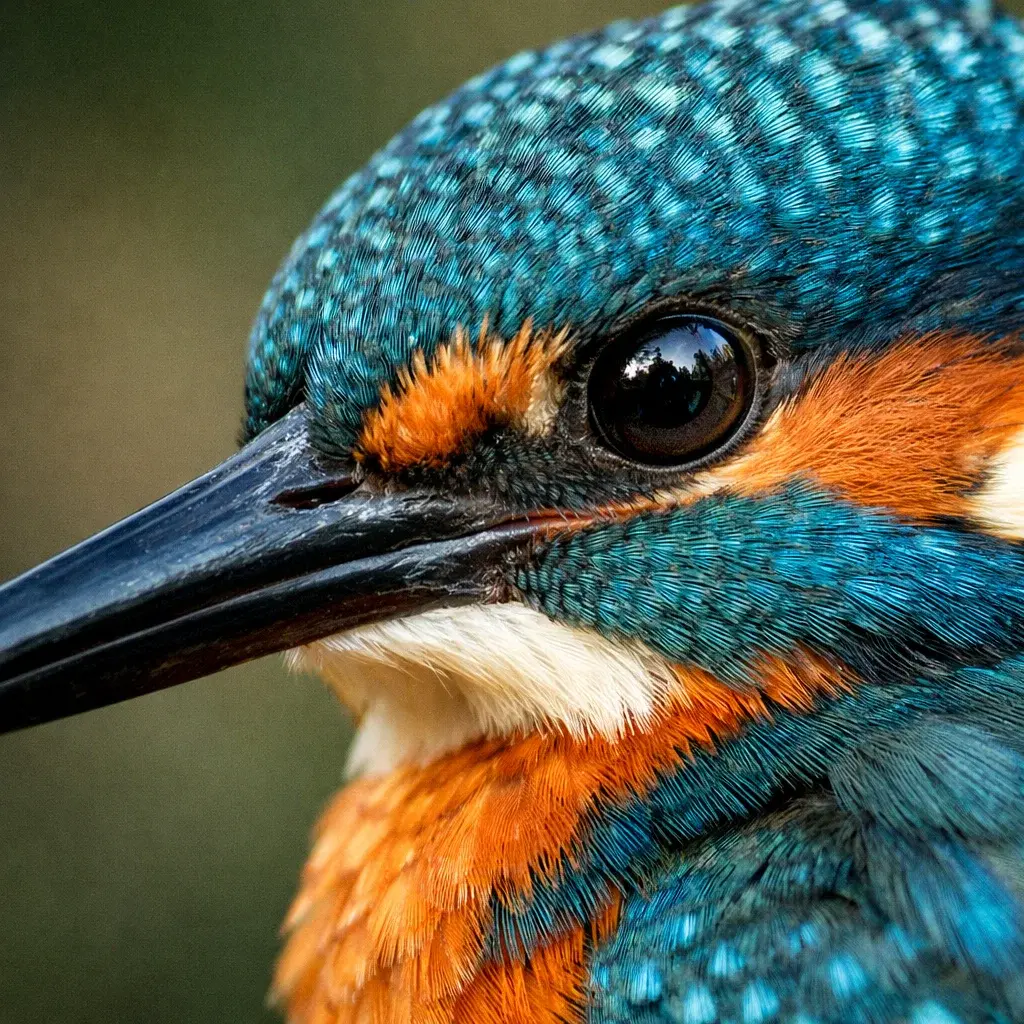
The brilliant sapphire and emerald hues of a Kingfisher are among the most vivid in nature. However, if you were to grind a kingfisher feather into a powder, it would appear a dull, brownish-grey. This is because the Kingfisher colour is not the result of blue pigment. Instead, it is a phenomenon known as structural coloration.
The feathers contain microscopic structures that utilize the Tyndall effect. These structures are arranged in such a way that they reflect only the blue and green wavelengths of light while absorbing others. This is why a Common Kingfisher can seem to “glow” in the sunlight but appear almost black in deep shadow. This shimmering effect serves a dual purpose: it acts as a visual signal for territory and mating, and it provides a form of “counter-shading” camouflage. From above, the blue blends with the water; from below, the orange-rufous underparts—which are colored by actual pigments known as carotenoids—mimic the sunlight filtering through the canopy.
Hunting Ethology: The Kingfisher fish Strike

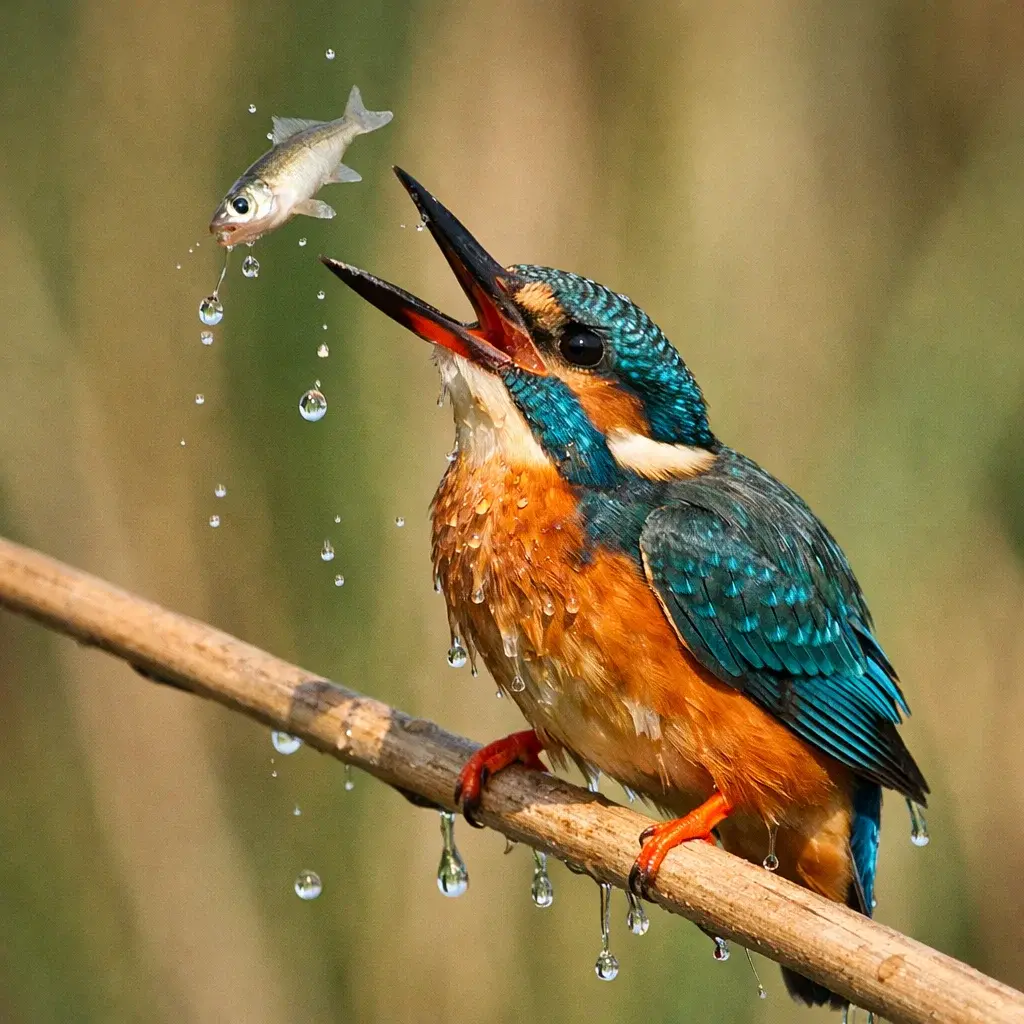
The primary focus of the Kingfisher diet for the river-dwelling species is, unsurprisingly, fish. The hunting process is a study in patience followed by explosive action. A kingfisher will spend hours on a “fishing perch”—a branch or reed overhanging the water—remaining perfectly motionless.
Once a target is sighted, the bird enters a state of high-intensity focus. It may hover momentarily to gain a better angle before plunging vertically. The dive is usually shallow, as the bird’s buoyancy prevents it from diving deep. It uses its beak like a pair of forceps to grab the fish behind the gills.
After a successful catch, the bird returns to its perch. Here, a gruesome but necessary ritual occurs. Because fish have sharp fins and scales that can cause internal damage, the bird must kill the prey before swallowing. It holds the fish by the tail and beats it repeatedly against the branch until it is limp. Then, the bird flips the fish and swallows it head-first, ensuring the fins fold down smoothly. This process is essential for the bird to safely process its Kingfisher fish intake.
Diversity in the Kingfisher diet
While the “river” varieties are piscivorous, the broader Kingfisher diet across the Alcedinidae family is surprisingly diverse. The “tree kingfishers” (Halcyoninae), such as the Laughing Kookaburra or the Sacred Kingfisher, often live far from water and rarely eat fish.
Their diet includes:
- Invertebrates: Large insects, beetles, dragonflies, and grasshoppers.
- Terrestrial Vertebrates: Small lizards, snakes, and even small rodents.
- Other Birds: Some larger kingfisher species are known to raid the nests of smaller birds.
- Crustaceans: Mangrove and coastal species focus heavily on crabs and shrimp.
Regardless of the specific prey, the hunting method remains similar: a sit-and-wait approach followed by a sudden, high-speed pounce. This “perch-to-ground” or “perch-to-water” strategy is the hallmark of the family’s predatory behavior.
Deciphering the Kingfisher sound and Communication
The Kingfisher sound is rarely musical in the way a nightingale’s song is. Instead, it is functional, loud, and piercing. Because these birds often live near running water, which creates a significant amount of “white noise,” their vocalizations have evolved to be high-frequency whistles that can cut through the sound of a river.
The most common call of the Common Kingfisher is a sharp, shrill “chee-kee” or “tsee.” This is frequently heard when the bird is in flight, serving as a territorial marker. During the breeding season, males may use a repeated, rhythmic version of this whistle to attract a mate.
For the larger tree kingfishers, the Kingfisher sound can be much more complex. The Kookaburra, for example, is famous for its “laughing” call, which is actually a social bonding mechanism and a way to establish family boundaries. These vocalizations are essential because kingfishers are highly territorial and solitary birds; they use sound to keep competitors at a distance without having to engage in physical combat, which could damage their delicate beaks.
Comparative Data: Species of the Kingfisher Family
To understand the scale of diversity within the family, we can compare the iconic river species with its water and tree-dwelling relatives.
| Category | Common Kingfisher | Pied Kingfisher | Laughing Kookaburra |
| Scientific Name | Alcedo atthis | Ceryle rudis | Dacelo novaeguineae |
| Subfamily | Alcedininae (River) | Cerylinae (Water) | Halcyoninae (Tree) |
| Average Weight | 35g – 45g | 70g – 95g | 300g – 450g |
| Primary Diet | Small Fish | Large Fish | Snakes, Lizards, Insects |
| Hunting Style | Perch-and-Dive | Hover-and-Dive | Perch-and-Pounce |
| Nesting Habitat | Riverbank Burrows | Riverbank Burrows | Tree Hollows |
How rare is a kingfisher?
If you are a birdwatcher, you might ask, “How rare is a kingfisher?” The answer depends largely on the quality of the local environment. Globally, the Common Kingfisher is listed as “Least Concern” by the IUCN because of its massive geographical range. However, on a local level, they can be quite rare and are often used as “bio-indicators.”
Environmental Sensitivity
Because the Kingfisher relies on visual hunting, it requires clear, unpolluted water. If a river becomes turbid due to agricultural runoff or industrial pollution, the bird can no longer see its prey and will abandon the area. Similarly, they are highly sensitive to hard winters. Because they are small and have high metabolisms, a week of frozen water can lead to mass starvation. In the United Kingdom, for instance, the species is “Amber Listed,” meaning it is a bird of conservation concern due to these localized vulnerabilities.
Habitat Fragmentation
In tropical regions, several species of kingfisher are truly rare and endangered. The Marquesan Kingfisher and the Guam Kingfisher have faced near-extinction due to habitat loss and invasive species. .In these contexts, the rarity is extreme, often requiring intensive captive breeding programs to prevent the complete loss of the species.
Literature and Education: The Kingfisher book
The name “Kingfisher” has become synonymous with clarity and the pursuit of knowledge, largely due to the success of the Kingfisher book brand. Kingfisher Publications, a British publishing house founded in the 1970s, chose the bird as its emblem because it represents speed, precision, and the ability to “dive deep” into a subject.
For many children, their first introduction to the natural world comes from a Kingfisher book. These encyclopedias and field guides are noted for their high-quality illustrations and authoritative text, mirroring the bird’s own reputation for visual brilliance.
This connection between the bird and the world of education has helped foster a sense of conservation in younger generations, ensuring that the bird is seen not just as a predator, but as a symbol of the beauty and complexity of the natural world.
Ancient Lore: What does the kingfisher symbolize?
Beyond its biological reality, the bird occupies a significant place in the human psyche. When asking “What does the kingfisher symbolize?” one must look at both Western and Eastern traditions.
1. The Halcyon Days
In Greek mythology, the kingfisher is tied to the story of Alcyone and Ceyx. When Ceyx was lost at sea, Alcyone’s grief was so great that the gods transformed the couple into kingfishers. The “Halcyon Days” were the fourteen days of calm weather around the winter solstice when the sea was supposedly stilled by the gods so that the kingfisher could lay its eggs in a floating nest. Today, the bird remains a symbol of peace, tranquility, and “calm before the storm.”
2. Native American Traditions
Among various Native American tribes, the Kingfisher is a symbol of success and the reward for patience. Because the bird spends so much time waiting for the perfect moment to strike, it is seen as a totem for hunters and providers. Some legends suggest that the kingfisher was originally a grey bird that stole the blue of the sky and the fire of the sun, explaining its vibrant plumage.
3. Prosperity and Vigilance
In modern symbolism, the bird represents vigilance. Its ability to sit perfectly still while the world moves around it is a lesson in mindfulness. To see a kingfisher is often considered a sign of impending prosperity or a reminder that a period of stagnant “waiting” is about to result in a successful “catch.”
Nesting Architecture and Reproduction
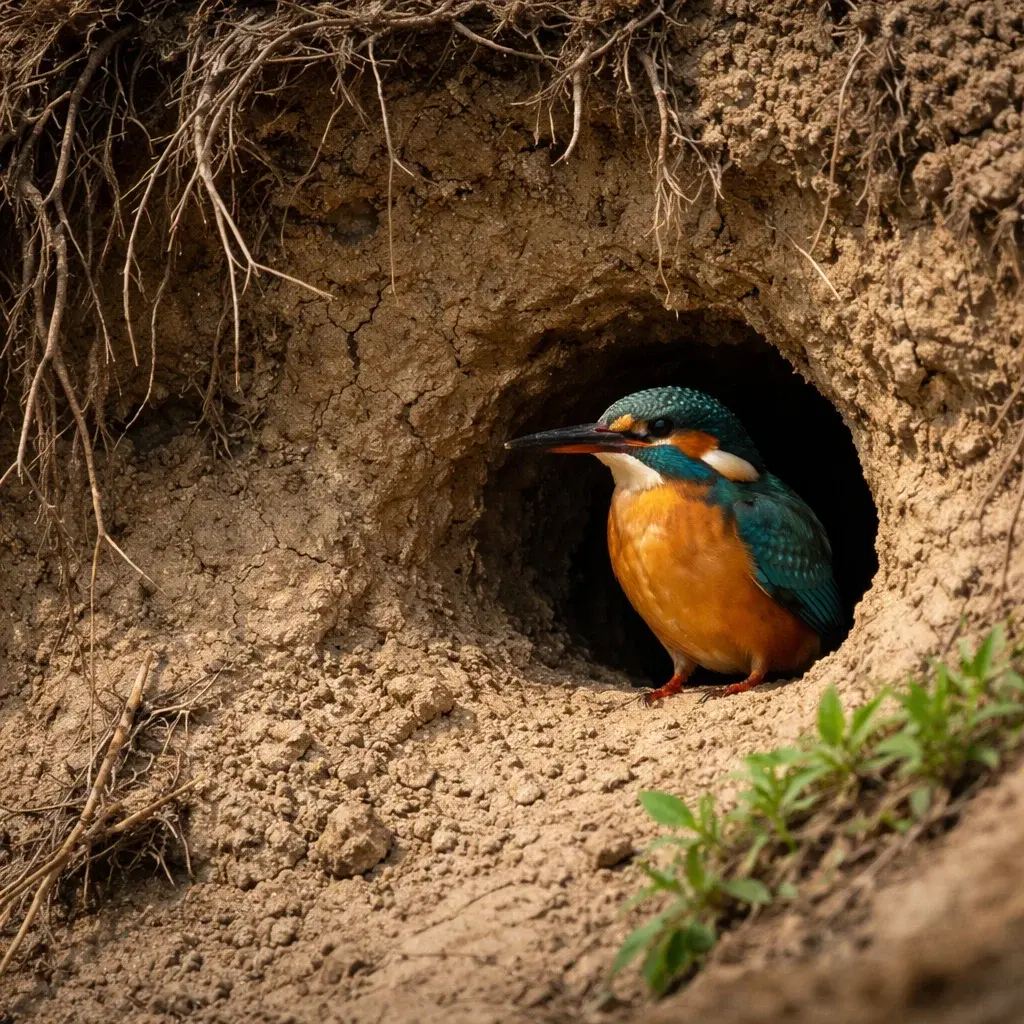
The reproductive cycle of the Common Kingfisher is a high-stakes endeavor that takes place hidden from view. Unlike most birds that build nests in trees, the river kingfisher is a fossorial nester—it digs.
Using their beaks and feet, both the male and female spend up to two weeks excavating a tunnel into a vertical sandy riverbank. These tunnels can be up to 90 centimeters long and slope slightly upward to prevent flooding. At the end of the tunnel is a nesting chamber where the female lays 5 to 7 white, glossy eggs.
One of the most unusual aspects of the nesting chamber is that it is not lined with soft grass or feathers. Instead, it is lined with the indigestible remains of the Kingfisher diet. As the chicks grow, they regurgitate pellets of fish bones and scales.
Over time, these accumulate to form a “cushion” of bones. While this sounds unappealing to humans, it provides a dry, insulating layer for the developing chicks. The parents must work tirelessly, often making up to 100 trips a day to provide enough Kingfisher fish to satisfy their rapidly growing offspring.
Threats to the “Blue Bolt”
While the Kingfisher is a resilient hunter, it faces significant anthropogenic threats in the 21st century.
- Water Pollution: Chemical runoff from farms and factories can lead to the bioaccumulation of toxins in fish, which then poisons the kingfishers at the top of the food chain.
- River Management: The “canalization” of rivers—straightening them and lining them with concrete—removes the natural earthy banks the birds need for nesting.
- Human Disturbance: Kingfishers are shy. Increased recreational use of rivers (kayaking, fishing) during the breeding season can cause parents to abandon their nests.
- Climate Change: Unpredictable weather patterns, such as flash floods during the spring, can drown nests that are built too low in the riverbank.
Conservation efforts are now focused on restoring natural river flow and installing “artificial nesting banks” in urban areas to give the birds a safe place to breed away from human interference.
Summary of Kingfisher facts
To wrap up this extensive look at the Alcedinidae family, let us summarize the most critical points regarding their existence:
- Structural Color: The blue Kingfisher colour is a result of light scattering, not pigment.
- Master Hunters: Their dual-foveae vision allows them to see through the glare of the water and strike prey with 99% accuracy.
- Global Presence: From the Common Kingfisher in London to the Kookaburra in Sydney, they are found worldwide.
- Dietary Specialists: While they love a Kingfisher fish, they are opportunistic and will eat anything from lizards to dragonflies.
- Cultural Icons: They represent the “Halcyon” peace of ancient Greece and the educational clarity of the Kingfisher book.
- Environmental Sentinels: Their presence is the ultimate indicator of a healthy, unpolluted waterway.
A Legacy of Brilliance
The Kingfisher is more than just a bird; it is a biological masterpiece that bridges the gap between the sky and the river. From the unique Kingfisher sound that echoes through the morning mist to the mathematical precision of its hydrodynamic beak, every aspect of this bird is a testament to the power of specialized evolution.
Whether you are a student of ornithology, a reader of a classic Kingfisher book, or a casual observer lucky enough to spot the “blue bolt” on a summer afternoon, the kingfisher demands our respect and our protection. By ensuring the health of our rivers and the clarity of our waters, we ensure that the Common Kingfisher continues its ancient, shimmering dance for millions of years to come. In a world of constant movement, the kingfisher teaches us the value of sitting still, watching closely, and striking when the moment is exactly right.
Stay wild, stay curious – only on PetNarianPets!
Join The Fun On Instagram, X, Pinterest and YouTube.
Wanna Say Something about animals ? Contact Us.